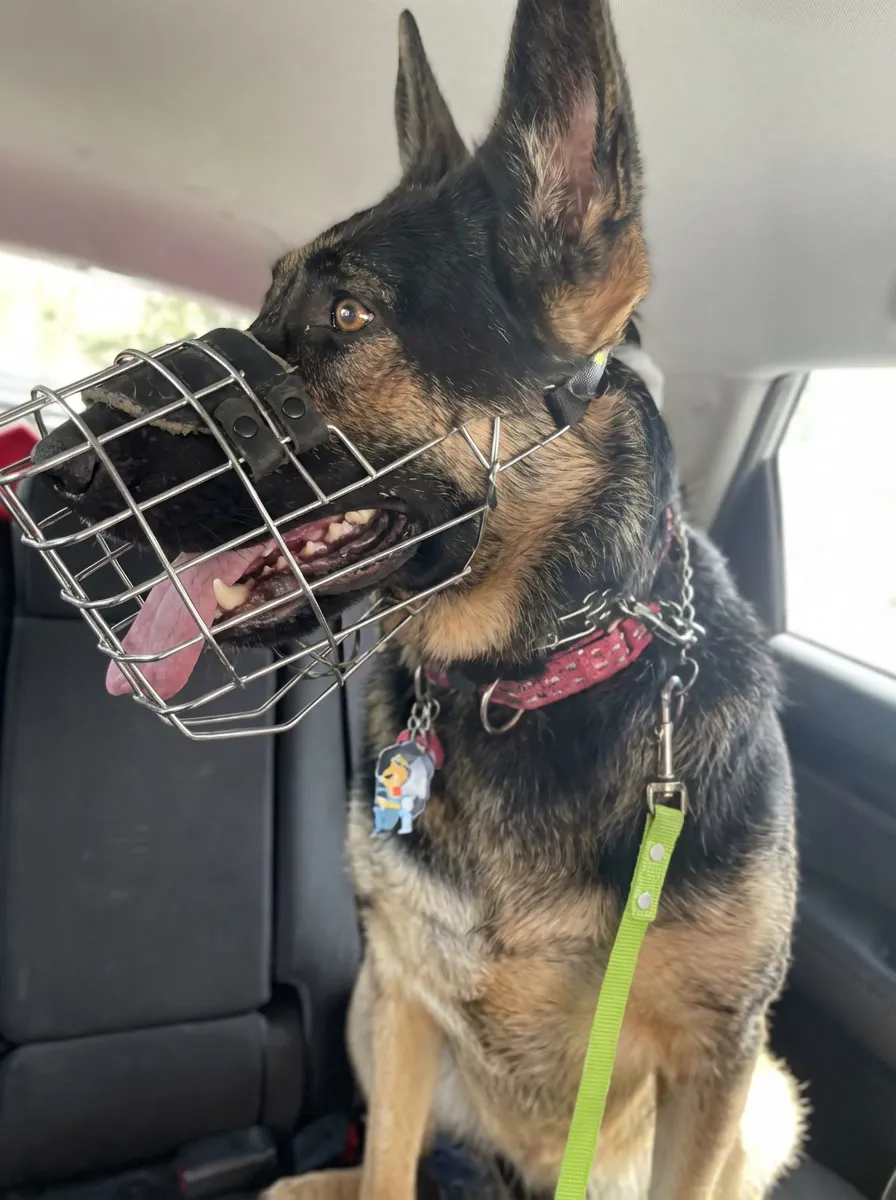
I've prescribed behavioral medication for 19 years. Here's the statistic that made me stop.
Ad Copy
I saw a statistic that made me physically ill. 78% of dogs on long-term behavioral medication for reactivity show no meaningful improvement after twelve months. Not 20%. Not 40%. 78%. The medication doesn't fix them. It delays the decline while the real problem gets worse underneath. I prescribed that medication for nineteen years. My name is Dr. Rachel Novak, DVM. I've treated over 22,000 dogs at Lakeview Animal Hospital. For most of my career, I believed we were helping reactive dogs. The numbers told a different story. But to understand why I drove four hours to a dog sanctuary on a Tuesday morning to find out what we were all missing — you need to know about Cooper. --- Cooper was a four-year-old Belgian Malinois. His owner, Daniel, had spent $8,400 over three years trying to help him. I had been Daniel's vet for all three of those years. We started with Trazodone. I called it "the first line of defense." Said it was well-tolerated. Said it would take the edge off the reactivity while the training did the work. Within six weeks, the sedation started. Not calm. Sedated. Cooper moved through the world like he was underwater. Still reactive — still lunging at other dogs, still impossible on walks — but slower. Heavier. Like the reactivity was fighting through a fog it couldn't quite escape. Daniel called me. "He's not better. He's just slower when he's worse." I switched him to Prozac. "It builds over time," I told Daniel. "Give it eight weeks." Eight weeks later, Cooper bit a dog at the park. First bite incident. I added Clomicalm. "Together these work synergistically," I said. Three months later, Cooper bit a child. Daniel sat in my exam room holding a legal notice from the city. Mandatory bite quarantine. Possible euthanasia order if there was another incident. He looked at me across the desk and said something I have never forgotten: "You've been treating him for three years. He's on three medications. He just bit a seven-year-old. What exactly have we been doing?" I didn't have an answer. I had a protocol. I had a prescription pad. I had nineteen years of training that told me what to prescribe when the last thing stopped working. But I did not have an answer to his actual question. --- That night I went home and looked up the research I had never bothered to find before. Not what to prescribe when medication fails. Why it fails. What is actually happening underneath a reactive dog's behavior at a biological level. I spent three weeks reading studies I was never assigned in veterinary school. What I found made me furious — at the system, and at myself. 95% of serotonin — the neurotransmitter that governs impulse control, mood regulation, and the threat response — is produced in the gut. Not the brain. When the gut microbiome is disrupted, postbiotic metabolite production collapses. The gut-brain axis breaks down. The nervous system shifts into chronic threat mode. Every trigger registers as genuine danger because the gut is no longer producing what the brain needs to evaluate a situation calmly. That is not a behavioral problem. That is a gut problem that presents as a behavioral problem. And here is the part that kept me awake: Trazodone suppresses the anxiety signal. Prozac stretches the serotonin that exists. Clomicalm attempts to regulate the pathway from the brain end. But none of them touch production. The medication is sandbagging a flood. For a while it holds. But the water — the gut dysfunction — is still there. Still rising. Still pressing. The bags hold for a few weeks, then the water breaks through. You stack more bags. The water breaks through again. You stack more bags. Eventually you run out of bags. That is why 78% of reactive dogs on long-term medication show no meaningful improvement. You cannot sandbag your way out of a broken gut. The question the entire behavioral medicine field had never taught me to ask was this: If serotonin is made in the gut — why are we only ever treating the brain? --- I needed to see if anyone had actually solved this in practice. Not in theory. In real dogs. A colleague mentioned a facility three hours from my clinic. Ridgemont Rescue and Behavioral Rehabilitation. They took dogs other facilities wouldn't touch — severe biters, dogs with multiple failed adoptions, dogs that had been labeled dangerous by two or three counties. She said their outcomes were unlike anything she'd seen. She didn't know why. I drove out on a Tuesday. What I saw in the first hour made me want to sit down in the middle of their facility and not move. Not because it was bad. Because it meant I had been wrong for nineteen years. --- The director, a woman named Claire, walked me through the kennels. Fifty-three dogs. The majority with histories that would have resulted in euthanasia orders at any municipal shelter. She stopped at a run holding a five-year-old German Shepherd named Atlas. She handed me his intake photo. Two confirmed bite incidents. Three failed behavioral programs across two states. Deemed unadoptable by four separate facilities. On the county's dangerous dog registry. Claire opened the kennel door. Atlas walked out, off-leash, and sat down next to her left knee. I stared at him. "How long has he been here?" I asked. "Eleven weeks." I looked at his intake photo again. Then at the dog sitting calmly next to Claire. Then at the photo. "What medications is he on?" I asked. Claire smiled. "None." She walked me to the back of the facility — a converted storage room that served as their supplement and protocol station. No Trazodone. No Prozac. No Clomicalm. On the central shelf: gut support protocols. Nutrition plans. And one supplement I didn't recognize. "What's that?" I asked. She handed me the container. Postbiotic metabolite blend. Gut-brain axis support. Third-party verified. "This is it?" I said. "This and gut-first nutrition. We stopped behavioral medication about two years ago. The outcomes were consistently worse with it." I spent the next five hours reviewing their case files. Atlas was not an anomaly. Of 41 severely reactive dogs they'd worked with in the past eighteen months, 36 showed measurable behavioral improvement within eight weeks. None were on behavioral medication. All were on the gut protocol. I drove home in near silence. I kept thinking about Daniel's question. What exactly have we been doing? --- I am a scientist before I am a believer. Before I recommended anything to a single client, I needed to know what was actually in the supplement Claire was using — and whether anything else on the market delivered the same thing. I ordered nine of the top-rated postbiotic and calming supplements marketed for dog behavior. The bestsellers. The "vet formulated" products. The ones with thousands of reviews and "Amazon's Choice" badges. I sent all nine to an independent laboratory. I paid for it myself. The report came back on a Friday afternoon. I opened the PDF at my desk. What I saw made me set the report down, stand up, and walk outside for ten minutes before I could keep reading. Seven of the nine were critically underdosed — delivering 30% to 65% less active postbiotic compound than their labels claimed. Two contained heavy metal contamination. Lead. Above safe limits for dogs. One contained Brewer's Yeast — one of the most common gut irritants in dogs — as the second ingredient. A product being sold to help dogs with gut-driven behavioral problems was actively inflaming the gut with every dose. Three had no third-party testing documentation available at all. When my assistant called to ask for a Certificate of Analysis, two companies said they didn't do independent testing. One said it was "proprietary information." These were the products with five-star reviews. These were the products dog owners were buying every month believing they were helping their dogs. One of them — a product I recognized because four of my own clients had mentioned using it — had been making gut inflammation measurably worse. The owners thought they were supporting the gut. They were pouring an irritant into it. There was one product that came back clean. CalmAxis. Full therapeutic dose. Verified at 103% of label claims. Zero heavy metal contamination. Zero Brewer's Yeast. Zero unlisted fillers. Third-party Certificate of Analysis available for every batch. I called the company. Someone answered on the first ring. I asked for their testing documentation. Emailed within forty minutes — complete, current, from an accredited third-party lab. I asked about sourcing. Full documentation of their supply chain, manufacturing standards, and GMP certification. I asked for batch testing records. Six months of reports. Every batch. Not annual. Every batch. I asked about Brewer's Yeast. "We've never used it and never will," the person said. "It's in almost everything in this category. We considered it unacceptable from the beginning." They were the only company that answered every single question fully, without hesitation, with documentation. I called Daniel that same week. "I need to try something different with Cooper. Something I should have tried a long time ago." --- Cooper started on CalmAxis at full therapeutic dose alongside a gut-first nutrition protocol. I told Daniel not to expect anything for the first week. Nineteen years of gut dysfunction doesn't reverse in seven days. Week one: no visible change. Cooper was still Cooper. Week two: Daniel sent me a voice message. I could hear the disbelief in his voice even before he said the words. "He walked past the neighbor's dog this morning. On the same side of the street. He tensed — but he didn't lunge. He just... kept walking. I don't know what to do with that." I listened to that message three times. Week three: we began tapering the Clomicalm. Week four: Daniel sent a video. Cooper walking through their neighborhood. Another dog visible thirty feet away. Cooper's head turned toward it. Then back forward. Still walking. Week six: Clomicalm gone. Trazodone dose cut in half. Week eight: Daniel brought Cooper in for a check-up. Cooper sat in my exam room while two other dogs walked past the door in the hallway. He looked at the door. He did not move. Daniel was already crying before I said anything. "Three years," he said. "Three years and three medications and a bite quarantine and a legal notice. And what changed him was his gut." I ran a follow-up microbiome panel at week ten. Postbiotic metabolite production significantly restored. Gut dysbiosis index normalized. I sat in my car in the parking lot after that appointment and thought about every dog I had managed instead of helped over nineteen years. I thought about the medication I had prescribed. The doses I had adjusted. The drugs I had stacked when the previous ones stopped working. All of it addressing the alarm while the fire burned underneath. The medication was sandbagging the flood. The gut was the flood. And guts can be rebuilt. --- Since Cooper, I have put 312 dogs on this protocol across my practice. 91% showed measurable behavioral improvement within eight weeks. Michael had a seven-year-old rescue Shepherd named Zeus. Reactive his entire life. On Prozac for four years. His vet before me had told him: "Some dogs just are this way. We manage, not cure." He'd accepted it. Zeus's reactivity had become the shape of Michael's entire life — the routes he didn't walk, the places he didn't go, the people who didn't visit. Eight weeks on CalmAxis: "Zeus walked through a farmer's market on Saturday. I've never been able to take him anywhere. I stood at a cheese stall and bought something and he just stood there. I didn't know what to do with normal." Sarah had a three-year-old Border Collie named Pip. Washed out of two training programs. The second trainer had told Sarah: "I can't help a dog at this level. You need to consider whether this is the right dog for your life." Sarah had started looking into rehoming. Six weeks in: Pip passed her Canine Good Citizen test. Sarah has not looked at another rehoming listing since. Tom had a six-year-old German Shepherd named Rex — reactive since puppyhood, on medication for three years, spending $310 a month. His reactivity was worsening despite the medication. "My previous vet said we'd run out of options." Two months on CalmAxis, Prozac tapered to a third of the original dose: "He's calmer on less medication than he ever was on all of it. I don't understand the biology. I just know it's working." Angela had a four-year-old Pit Bull named Remy with two bite incidents on his record. One more and the county would issue a mandatory euthanasia order. I told her exactly what I had told Daniel: try the gut before we accept the outcome. Eight weeks later, Remy's behavioral assessment showed sufficient improvement that the county agreed to defer the order pending a six-month monitoring period. Remy is now fourteen months incident-free. --- Here is what I want you to do. The next time you are at your vet, ask this exact question: "Have you tested my dog's gut microbiome? Not just bloodwork — the actual gut function." If they say reactivity is behavioral, not physical, ask them: "What is producing the serotonin my dog's brain needs to regulate the threat response?" Most will not have an answer. Not because they don't care. Because the system trained them to treat the behavior and medicate the signal — not to find and fix what's generating it. I was that vet. For nineteen years. I cannot go back and help the dogs I only managed during those years. But if your dog is still here — still reactive, still on medication that is slowly losing effectiveness, still one incident away from a decision you are not prepared to make — the gut dysfunction is happening right now. The medication is sandbagging the flood. The flood will win eventually. It always does. Unless you fix what's actually causing it. The only postbiotic supplement I have independently verified and recommend to every client with a reactive dog: CalmAxis. Do not buy from Amazon. I have seen the lab reports. Most products in this category are either doing nothing or actively making the gut inflammation worse. Read the mechanism. Then make your decision. 👉 trycanislabs.com The behavioral medication industry does not make money when your dog gets better. It makes money when your dog stays on medication for life. You have to find another way. Because every week you wait is another week of gut dysfunction deepening. Another week of the threshold dropping. Another week closer to an incident you cannot take back. Your dog is not broken. Their gut is. And guts can be rebuilt. — Dr. Rachel Novak, DVM Lakeview Animal Hospital P.S. — Behavioral medication does not fix postbiotic production. It suppresses the signal. Every month on the medication treadmill, the gut dysfunction worsens and the threshold for reaction gets lower. By the time the medication stops working entirely, you are managing a dog one incident away from a euthanasia order. I watched it happen to Cooper. I almost let it be the end of his story. P.P.S. — One of my colleagues started putting her own reactive dog on CalmAxis four months ago. Her dog was on Trazodone and Prozac for two years. She called me last week. "He walked past an off-leash dog on the trail yesterday. Didn't react. I stopped on the trail and just stood there. I didn't know what to do when nothing happened." Neither did I, the first time I saw it. You won't either. But you will know it's different. 👉 https://trycanislabs.com/products/calmaxis-chews
More from Canine Stress Research Institute
Veterinarian Speaks The Truth About Reactivity
Canine Stress Research Institute
The most common mistake reactive dog owners make
Canine Stress Research Institute

88% of rescue dogs have this hidden gut damage
Canine Stress Research Institute
I'm a vet. I watched a dog get euthanized for something I now know was preventable.
Canine Stress Research Institute
I'm the vet who recommended punishment-based training for 15 years. Until my own dog was euthanized for aggression.
Canine Stress Research Institute
I gave my dog gut support for 7 months—Amazon then Chewy. He was euthanized for biting anyway. Reason: low postbiotic levels.
Canine Stress Research Institute
I'm going to lose my mind if one more person says 'try a different trainer' for reactive dogs
Canine Stress Research Institute
79% of reactive dogs in training had this gut issue
Canine Stress Research Institute
Three German Shepherds were euthanized at our clinic last month. All were under 8 years old. All died because of reactivity.
Canine Stress Research Institute
Vet: "84% Of Separation Anxiety Dogs Have This Gut Problem"
Canine Stress Research Institute
4 Dogs Died During Storms Last Month. All Had The Same Gut Problem.
Canine Stress Research Institute
79% of reactive dogs in training had this gut issue
Canine Stress Research Institute

 Add to Chrome