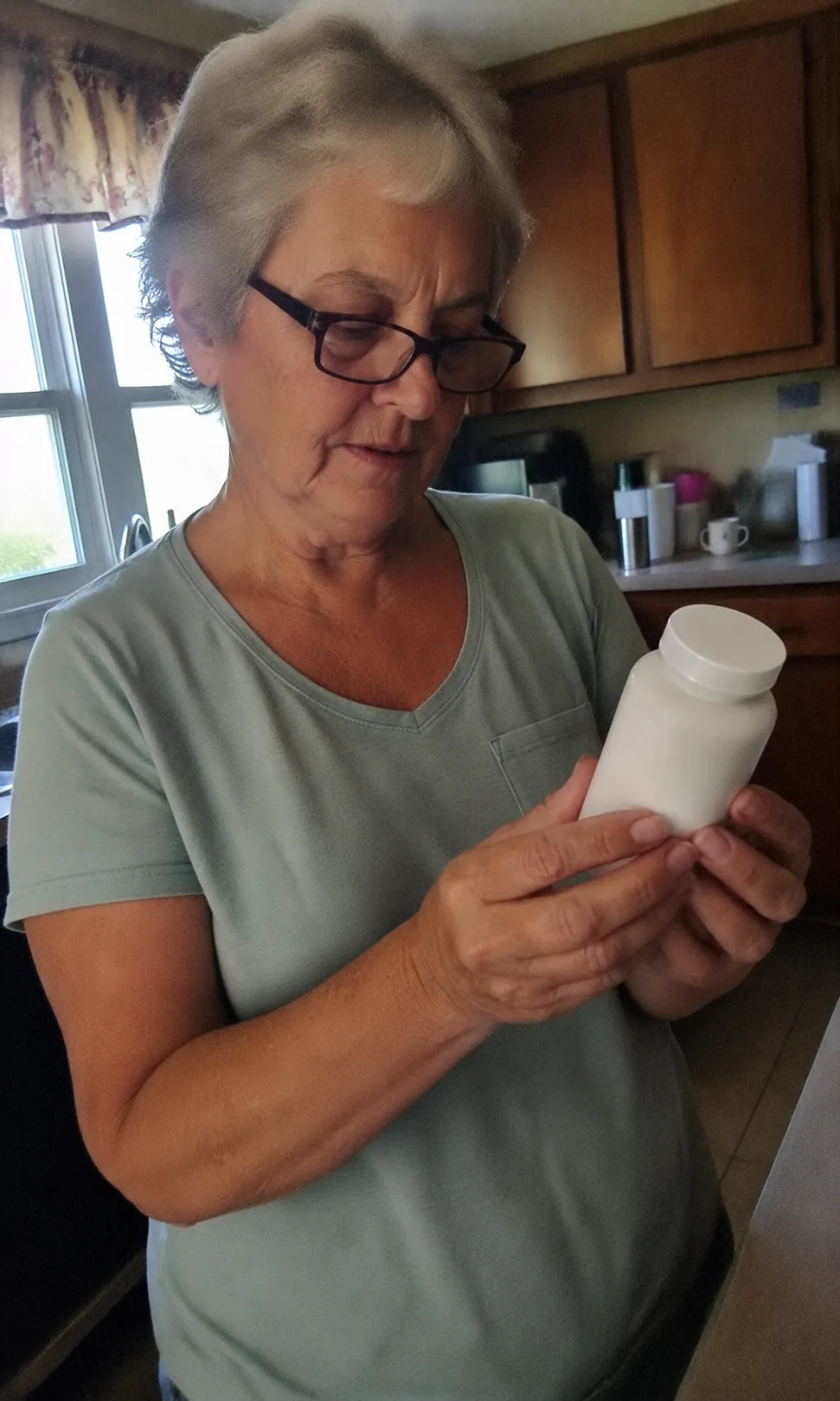
Support stamina and heart health every day
Ad Copy
This Ad Contains a Short List of Facts, and No Promises. That's the Whole Pitch. Somewhere in your kitchen, there is probably a label you have never finished reading. Not because you don't care. Because it wasn't written to be finished. Go look, if you want. We'll wait. This ad is going to ask you to check things anyway, so you may as well start warmed up. The granola bar with forty lines of ingredients, eleven of them in parentheses. The bottle in the cabinet with a "proprietary blend" — a single milligram total on the front, the recipe undisclosed, like a stew served with the lid glued on. The bag of anything at all, where the ingredient list runs in type small enough that reading it feels like an eye exam, and half the words sound like chemistry and half sound like marketing, and there is no way to tell from the outside which is which. Reading a modern label is a job. It wasn't always. There was a time — your grandmother's pantry, roughly — when the label on a jar told you what was in the jar, and the sentence ended there. Flour. Tomatoes. Beets, vinegar, salt. The label was short because the truth was short. Somewhere between that pantry and your kitchen, labels stopped being written for the person holding the package. They started being written for other purposes — to comply, to impress, to fill the panel. And somewhere along the way, all of us, quietly, without a meeting, agreed to stop reading them. Think about how strange that actually is. These are the things we eat and swallow. And the standard consumer move — the normal move, the one everyone makes — is to flip the package over, look at the wall of text, and put it in the cart anyway. We didn't stop reading labels because we stopped caring. We stopped because somewhere deep down we concluded the label wasn't going to tell us anyway. We'd like to talk about that. Because we make a supplement — and we know exactly how hard our own aisle can be to read. You may have seen the blend construction before. A milligram number in bold on the front. Turn it over: the number belongs to a "blend." The blend has a name — something with "matrix" or "complex" in it — and under the name, a list of ingredients in descending order, with no amounts attached to any of them. The total is disclosed. The parts are not. You are holding the package in your hand, reading every word on it, and you still cannot answer the only question you came with: how much of the thing is in the thing? We looked at that construction and made a different choice, and this whole ad is really just that choice, explained. Here is the entire formula of Rosabella Beetroot, read aloud, in one breath: Organic beetroot powder. 1,300mg per serving — a serving being two capsules. That's the active ingredient. That's also the whole list of active ingredients. The capsule itself is vegetable-based, and the other ingredients are listed on the label too. One breath. You didn't need a search engine. You didn't need a chemistry degree. You didn't need to call our customer-service line and sit through hold music to learn what you'd already paid for. You needed one breath, and now you know what's in the bottle — which should be the least an ad can do, and has somehow become a differentiator. We want to walk through the rest of it the same way. Slowly, one fact at a time, with the same rule holding for every line: Nothing in this ad should require trusting us. That's the standard. Not "trust us, we're the honest ones" — saying that is free. The standard is stricter: every statement in this ad should be the kind of statement a stranger could verify without our cooperation. If a sentence can't meet that bar, our rule is that the sentence doesn't run. So. The facts, and where to check each one. The dose. 1,300mg of organic beetroot powder per serving. Printed on the front of the label, in numerals, attached to the actual ingredient rather than a blend name. Two capsules is a serving; the math per capsule is yours to do, which is the point — you can do it, because you have both numbers. The formula. One active ingredient. Not "one ingredient" — we just told you about the capsule and the other ingredients, because rounding them away would be a small lie in service of a cleaner sentence, and small lies in service of clean sentences are most of what's wrong with labels. One active ingredient. The distinction is on the label. Check it. The testing. Third-party lab tested — a lab that isn't us, which is what "third-party" has to mean or it means nothing. Produced under Good Manufacturing Practices. Both on the label. Check them. The basics. Non-GMO. No caffeine. On the label. Check. The origin. Made in the USA from globally sourced ingredients. You'll notice that's the long version. The short version is one we're not entitled to, because some ingredients are sourced globally, and the accurate sentence is the one that says so. We print the qualifier where the claim appears. Every time. That's not modesty; that's just what the sentence costs if you want it to be true. The count. Sixty capsules in a bottle. Two capsules, once a day. Thirty days. Arithmetic you can audit in your head. The company. Ambrosia Brands LLC, Sheridan, Wyoming. A real name, a real place. Look us up. Companies that want to be findable print their name and city; we just did. The rating. On Amazon, Rosabella Beetroot sits at 4.4 out of 5 across more than 14,000 ratings, as of August 2026. Sit with that one for a second, because it's doing something the others aren't. It's not five stars. It's 4.4 — which means that among fourteen-thousand-plus ratings, some people were unimpressed, and their reviews are sitting right there in public for you to read. We're citing the number anyway, with the date attached, because you can go read the whole unfiltered spread yourself. We could have handed you our three favorite sentences under a row of gold stars. You're getting the aggregate instead, time-stamped, with directions to the source. Because an ad you have to believe is worth exactly the trust you extend it. An ad you can check is worth something better. Now — why beetroot at all? Fair question, and the answer is the one part of this story we can't take credit for. People have been eating beets for thousands of years. Before refrigeration, before vitamins had names, before anyone could have told you a single thing about why — beets were in the root cellars and soup pots and pickle jars of half the world's grandmothers, kept and replanted and put up every autumn on nothing more than the accumulated verdict of generations. Entire cuisines are built around them. They earned the shelf space the long way. Today the why is better understood: beetroot naturally contains dietary nitrates, and the body converts those into nitric oxide, a molecule that helps support healthy blood flow.* Beets also carry betalains — the deep crimson pigments that give beets their color, the ones that stain a cutting board for a week. Nature did the formulating a long time ago. Our contribution is honestly much smaller than ads usually admit: we put the beetroot in a capsule, and we printed the amount on the front. Which brings us to the part of the ad you've been bracing for. You know this part. You've read plenty of supplement ads; you know what comes after the ingredients. This is where the music swells. This is where we tell you what it will do for you — the mornings, the difference, the new you, soft light and violins. Except we're not going to. Not because we're coy, and not because we're saving it for the website. Because we can't verify it — and the rule of this ad, the one we set at the top, is that everything in it can be checked. A promise about your body fails that rule automatically. Nobody can check it in advance. Not you. Certainly not us — we've never met you. So here is what we won't say, stated as policy, in writing: Nobody here is going to promise you a transformation. Transformations make better ads than facts do. We know. We're choosing the facts. We're not going to tell you what you'll feel or when. Bodies are different, and yours doesn't owe an advertisement anything. We're not going to dress a promise up in photographs, either. We don't know where you're starting from, and we won't pretend to know where you'd end up. And we're not going to imply any of it sideways — no winking, no "you know why beets," no letting an image promise what the sentences carefully didn't. If we won't say it, we don't get to gesture at it. What we can promise is what's on the label. The label is the part we control. It is also — and this is worth saying to everyone, about every product — the only part anyone should ever let an ad promise them. One thing before anything goes in a cart: talk to your doctor or pharmacist before adding any supplement, especially if you take any medication. This goes alongside the rest of a routine — the meals, the walks, the sleep — not in place of any of it. And the guarantee, stated exactly, because guarantee language is where fine print traditionally lives: 90 days. If you're not satisfied, for any reason, return it within 90 days of delivery for a full refund. Read the wording once more. Any reason. Not "if you don't love your results" — tying a refund to results is just a promise wearing a receipt, and we've already told you where we stand on promises. You bought it, you're not satisfied, whatever your reason is: return it within 90 days of delivery, full refund. The reason is yours to have. So that's the ad. Count what's in it: One claim — asterisked, ingredient-level, the beetroot-and-nitrates sentence you read above, pointing to the disclaimer at the bottom. A list of facts — every single one printed on a label, posted on a public listing, or written into a refund policy. Checkable without our cooperation. And no promises. On purpose. In writing. As policy. Here's the position underneath it all, and you're welcome to hold us to it for as long as we're in business: An ad that promises you a feeling is asking for your trust. An ad you can check is offering you something better: the chance to not need trust at all. We'd rather be checked than believed. The label reads in one breath. The rating is public. The refund needs no justification. Start anywhere. P.S. If refusing to promise seems like a strange way to sell something — that's fair, and we'll give you the honest logic. Any promise about how you'll feel would be a guess dressed up as a guarantee, and you've been sold enough of those. We'd rather hand you the label, the real rating, and 90 days, and let the deciding happen in your own kitchen. P.P.S. What it is, one more time, plainly: organic beetroot powder in capsules — 1,300mg per two-capsule serving, one active ingredient, dose on the label, no caffeine, non-GMO, third-party lab tested. Thirty days a bottle. That's the whole story. P.P.P.S. The guarantee is satisfaction-based: not satisfied, for any reason, return it within 90 days of delivery for a full refund. Enough time to read the label, check the rating, and find out whether it belongs in your routine — which is the only test that matters for deciding that. Individual experiences vary. These statements have not been evaluated by the Food and Drug Administration. This product is not intended to diagnose, treat, cure, or prevent any disease.
More from Blood Pressure Secrets
Support stamina and heart health every day
Blood Pressure Secrets
Support stamina and heart health everyday
Blood Pressure Secrets

Support stamina and heart health everyday
Blood Pressure Secrets
Support stamina and heart health everyday
Blood Pressure Secrets
Support stamina and heart health every day
Blood Pressure Secrets
Support stamina and heart health every day
Blood Pressure Secrets
Support stamina and heart health every day
Blood Pressure Secrets
Support stamina and heart health every day
Blood Pressure Secrets
Support stamina and heart health every day
Blood Pressure Secrets

Support stamina and heart health every day
Blood Pressure Secrets

Support stamina and heart health every day
Blood Pressure Secrets

Support stamina and heart health every day
Blood Pressure Secrets

 Add to Chrome