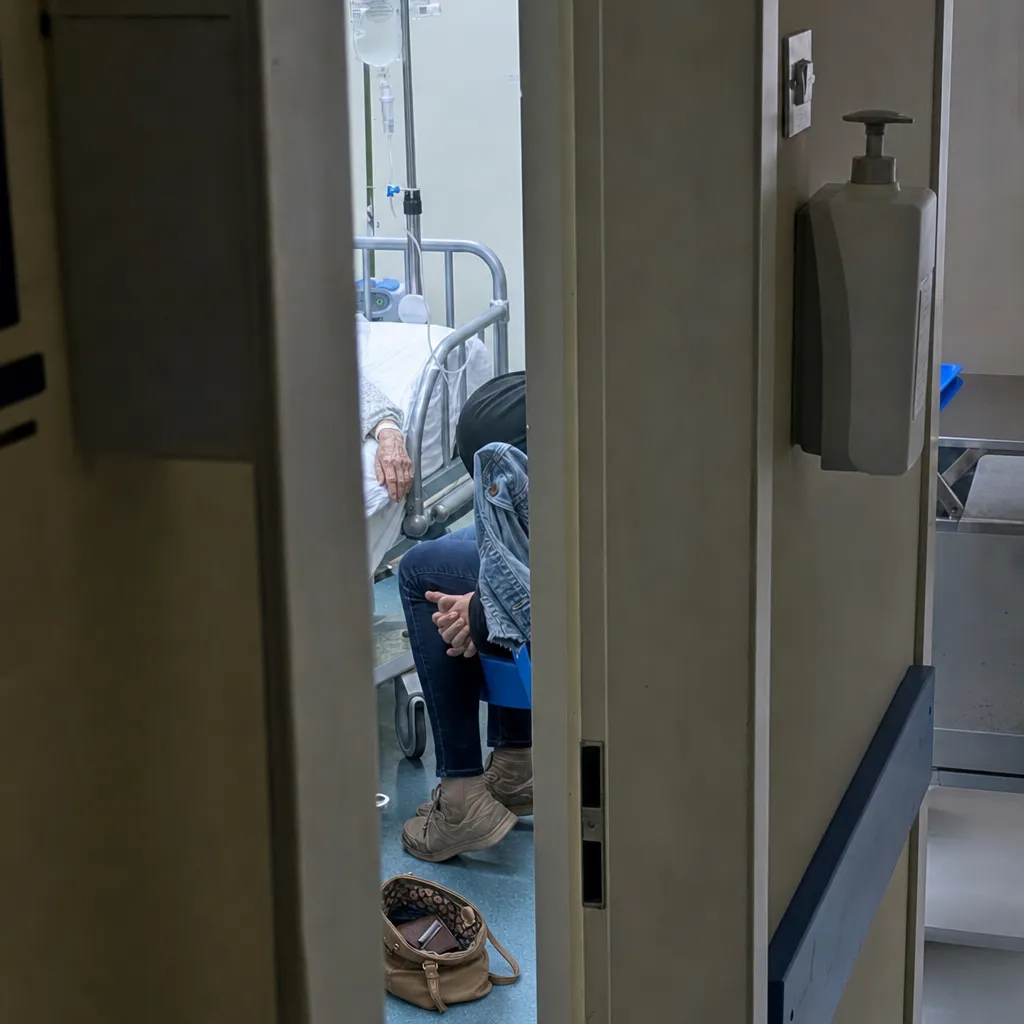
Read if you're having 10+ migraines every month☝️
Ad Copy
My mom has had chronic migraines since before I was born. She never ignored them or tried to "push through." She tried every preventative. Got Botox. Added Nurtec. Last October, an attack left her bedridden in the ER for 6 days. She was 52 years old. She took Sumatriptan the second she felt one coming. Got Botox every 12 weeks for years. Tried every preventative her neurologist put in front of her. When Nurtec came out in 2020 she was one of the first few patients to be prescribed it. She did everything her neurologists told her. That ER stay lasted 6 days. She came home and spent another 5 in bed. Her bedroom door is still the first thing I look at when I walk into her house. I hate seeing it closed. If it's closed, part of me is six years old again waiting for her to come out of that dark room. I need to tell you what happened to my mom. Because every week I see posts on Facebook from women like her, "Botox helps for a few months then stops," or "my triptan barely touches them anymore," and it makes me physically sick. If you're the daughter of a woman with chronic migraines, or you suffer from them yourself, please read this whole thing. I know it's long. I know you're scrolling. I know you have things to do. A few months ago I would have given anything, everything, for someone to explain what I'm about to tell you. My mom was in her early twenties when the migraines started. Nobody in the family knew what triggered them. There was no pattern anyone could point to. One day the pain showed up behind her left eye, and it never really left. A pounding pain drilling behind one eye, nausea so bad she had to lie perfectly still to keep from throwing up, and light was so unbearable to her that even the glow from the hallway made her pull the covers over her face. The first few times she blamed it on stress. On not sleeping enough. On being a new mom. But when they kept coming back, week after week, month after month, she started to realize this wasn't going away. She eventually took the pattern to a neurologist. "Chronic migraine," he told her. "We're going to try a preventative and see if we can get the frequency down." He prescribed Topiramate. Mom went home and started a notebook. She tracked every migraine, how long it lasted, whether she threw up, whether the medication stopped it or only pushed it back a few hours. For a while, that gave her hope. Some months the migraines came less often. Some months they were shorter. There were stretches where she thought they might finally have it under control. Then there were months when she took every prescription exactly when she was supposed to and still ended up completely incapacitated. The brain fog from the Topiramate got so bad she couldn't finish a sentence some days. She felt stupid all the time. Like a shell of herself. So she tapered off that. Next came beta-blockers. Then tricyclics. Each one bought her a few months before the migraines found their way back through. She kept trying because every new prescription came with the same possibility — maybe this was the one that would finally let her stop planning her life around her next attack. For years, she planned everything around her migraines. Trips got checked against how she'd been feeling. She stopped agreeing to weekend plans if she'd had a bad week. At my sister's first birthday, family came over for cake and pictures while Mom spent the whole afternoon upstairs with the curtains shut because another migraine had broken through anyway. Her entire life was revolving around preventing something she could never completely prevent. And she kept doing everything they told her to do. Because the neurologist said to. She took the preventatives. Tried every class of medication they had. Kept the notebook. Kept the rescue medication close. Went back every time something failed and tried whatever they gave her next. She did everything right. By the mid 2010s, her neurologist had another option. Botox. Thirty-one needles in her forehead, temples, and the back of her scalp every twelve weeks. It didn't do much besides make her forehead numb for three months. Migraines came right through it. Then in 2020, her neurologist had one more. Nurtec had just come out. My mom had been reading about it for months. Women in migraine groups were calling it the "miracle cure." After years of doing everything right, she finally thought this might be different. Her neurologist prescribed it and told her to keep tracking the attacks. So she did. August: 12 migraine days. September: 13. October 16th: 8 migraine days already. The worst month she had ever recorded. Mom came home from that appointment and sat at the kitchen table with the same black notebook she had been tracking everything in for years. She didn't say anything for a long time. Then she said, "I've tried everything they've given me. How is this getting worse?" I told her to give the Nurtec just one more time. I told her the neurologist said it could take a few months. I told her to trust the process. She nodded. She kept taking the Nurtec. She kept filling in the black notebook. She kept carrying her rescue medication everywhere she went. And before October was over, she had the worst migraine of her life. Nine days later — nine days — I woke up at 2:17 AM to my phone ringing. It was Mom. By the time I got to her house, she was sitting on the bathroom floor with an ice pack pressed against the side of her head and a towel over her face. She couldn't keep water down. She could barely open her eyes. I drove her to the ER. By the time they got her into a room, she couldn't tolerate the fluorescent lights at all. Not "they were bothering her." She physically couldn't open her eyes. The nurse shut off every light she could and Mom still kept the towel pulled over her face. The ER doctor — a woman who looked younger than me — went through her chart, the Nurtec, the Botox, the preventatives, everything she had already taken that night, and her face did this thing. "We're going to give you an IV migraine cocktail and try to break this. If we can't get the pain under control, we're admitting you." "But I took the Nurtec," Mom said. The doctor just looked at her. "I know. I'm sorry." Mom spent 6 days in the hospital. I learned things about migraines I never wanted to know. I learned what a "migraine cocktail" was because I watched them hang one after another beside her bed. I learned that sometimes the pain would drop from a nine to a six and everyone would get excited, only for me to come back a few hours later and find the room dark again with Mom curled on her side holding her head. I learned that when a migraine refuses to break for days, they call it status migrainosus. It means the attack just keeps going, long after the point where everyone expects it to stop, and the medications that normally give you some kind of escape stop being enough. For Mom, nothing was breaking it. Day 3, they gave her another migraine cocktail. For a few hours she said the pain was finally easing, but that night I walked back into the room and found the towel over her face again. Day 4, she tried to eat and threw it back up. The nurse brought another ice pack and Mom whispered, "I just want this to stop." Day 5, she stopped asking when she could go home. I sat beside her bed watching her lie perfectly still in that dark room and realized I was six years old again. Same ice pack. Same Mom. Same feeling that maybe if everyone stayed quiet enough and kept the lights off, eventually she would come back. Except now I was sitting in a hospital instead of outside her bedroom door. Day 6, the pain finally came down enough for them to discharge her. I drove her home that afternoon. The black notebook was still sitting on the kitchen table with the Nurtec beside it. Her ice packs were stacked in the freezer, the blackout curtains upstairs were still closed, and after six nights in the hospital she walked through the front door and went straight back to the same dark bedroom she had spent years trying to stay out of. I sat downstairs for almost two hours looking at that notebook. Thirty years of prescriptions, appointments, preventatives, and doing exactly what she was told, and we had just spent six nights in a hospital trying to stop one migraine. A few days later, I brought my daughter over to check on her. She stood at the bottom of the stairs, looked toward Mom's bedroom and asked me, "Is Nana still in the dark room?" I told her Nana's head still hurt and that we needed to keep our voices down. She nodded, waited a second, then whispered, "Can she come downstairs today?" I knew those rules before she even asked. Don't turn the lights on. Keep your voice down. Don't open the bedroom door. Maybe Mom will come downstairs later. They were the same rules I had learned when I was her age, and now I was standing there teaching them to my own daughter. After Mom came home, I tried to go back to normal. I couldn't. Because every time I opened Facebook I saw women like my Mom posting things like, "My preventative worked for a few months then just stopped." Or, "I've tried everything and the migraines keep getting worse. What else am I supposed to do?" And I knew — I KNEW — some of them were doing exactly what Mom did. The prescriptions. The Botox. The Nurtec. The tracking. And still ending up feeling as if their body were betraying them. I couldn't just sit there and watch it happen. So I started researching. Not because I wanted to. Because I had to. Because if Mom could spend more than thirty years doing everything her doctors told her and still end up hospitalized for six days — if my daughter was already learning the same rules I learned as a kid — then I needed to know what everyone was missing. I read for weeks. Neurology papers I had to read three times to understand. Migraine forums where women described Mom's exact treatment history. And one thing kept coming up, over and over, that no neurologist had ever explained to us. There's a nerve called the trigeminal nerve. It runs across the entire head and face. Every migraine Mom ever had started there. But here's what nobody told us: that nerve doesn't reset after an attack. Each migraine leaves it a little more sensitive than it was before. It doesn't go back down. It only climbs. Every medication Mom had ever been on — the Topiramate, the beta-blockers, the Botox, the Nurtec — they were all designed to block the pain or stop the attack. Not one of them was built to calm the nerve that was getting more reactive underneath all of it. Read that again. Mom wasn't ending up in that dark room because she wasn't treating the migraines aggressively enough. She had been treating them aggressively for thirty years. The medications were holding a lid over the top. But the nerve underneath kept getting more sensitive with every single attack. Eventually the lid couldn't hold anymore. That's why the Topiramate worked and then stopped. That's why Botox didn't touch it. That's why Nurtec worked for a few months and then her worst month ever followed. She spent thirty years trying to stop the attacks without anyone ever addressing the nerve that was generating them. I sat with that for three days. Then I found the research. A researcher named Dr. Rami Burstein at Harvard had accidentally discovered something in 2016 while testing different wavelengths of light on migraine patients. Every color on the spectrum made the patients' attacks visibly worse. Except one. Green light, at exactly 520 nanometers. The only one in the entire trial that brought pain down instead of agitating it. But green light didn't get marked down as just pain relief. A group of researchers at the University of Arizona wanted to see if it could have a longer-term effect. So they took a group of migraine patients who'd failed every medication on the market and put them on a green light protocol for ten weeks. The results: 60% of them saw their migraines drop down to single digits a month. My first thought was — you have got to be kidding me. Light therapy. For migraines. Mom couldn't even tolerate the glow from the hallway during an attack, and I was reading that light was the answer. But this wasn't light in general. It was one specific wavelength. And the research wasn't some wellness blog. It was Harvard. Published. Peer-reviewed. From what I could piece together, that specific green light hits the eye and travels down the same visual pathway that's tangled up in all of this. But instead of setting off a strong reaction the way normal light does, it barely registers. Just a small, weak signal. Doing that over and over, apparently, is what eventually calms the nerve back down. There was something else in there too, about the light actually getting the brain to make its own natural painkillers. The same category as morphine, just something the body was already capable of producing. I don't fully understand all the science. But the best way I could sum it up is that it's like physical therapy for one specific nerve. You retrain it until it stops overreacting, the same way you'd retrain an overreacting joint. Just through the eyes instead of a resistance band. I verified every source I could find. The Harvard study was real. The Arizona trial was real. That night I searched Amazon for "green light therapy for migraines." A dozen bulbs came up. I ordered two, screwed one into the lamp on Mom's nightstand and one in the living room. Told her to keep them on whenever she was in either room. A couple weeks went by. Mom's migraines didn't get any better. And Dad was losing his mind because the whole house looked like the inside of an aquarium. So I went back to the Harvard study and reread it more carefully. 520 nanometers. Narrow-band. Precisely calibrated. I'd completely glossed over that part the first time. I went and looked at the Amazon listing for the bulbs I'd bought. No wavelength mentioned anywhere. Not on the listing. Not on the box. Nothing. I took them both down that night. Then I started looking through migraine forums to see what people who actually suffered from this were using. Not what Amazon was selling. What was actually working. The more I read, the more I understood why the bulbs didn't do anything. A regular green light bulb emits a broad spectrum. It looks green, but it's scattering wavelengths all over the place, including ones the research showed actually make the nerve worse. The 520 nanometers the Harvard study used is one precise point on that spectrum. A green bulb doesn't hit it. It just looks like it should. From what I could gather, three things actually mattered. The wavelength had to be narrow-band, precisely at 520 nanometers. Not broad spectrum that just looks green. It had to be medical grade. Built to deliver that wavelength at the intensity the research actually used. Not a mood lamp. Not a colored bulb in a fancy housing. And it had to deliver the light directly. Not bounced off walls and ceilings across a room where it loses half its precision before it ever reaches you. I went back through everything I'd seen. Green lamps. Green bulbs. LED panels. None of them hit all three. Most of them didn't even list a wavelength. But in the forum comments, one name kept coming up every so often. Vivee. A green light face mask that delivered 520nm of green light, was medical grade, and could be worn daily for 10 to 20 minutes. At first a face mask sounded weird, until I remembered I'd just spent two weeks turning my mom's house into an aquarium with the wrong lightbulbs. But this Vivee face mask checked every box and looked promising enough. So I ordered it that night. When the mask came, I brought it over and set it on the kitchen table beside the same black notebook she had been filling with migraine days for years. When she came downstairs, I explained the trigeminal nerve, the Harvard research, the 520 nanometer wavelength, and why this was different from anything her neurologist had ever given her. She looked at the mask for a few seconds and said, "I've already tried everything." "I know," I told her. "Just give me two months." She did. She didn't stop the Nurtec, throw away her rescue medication, or suddenly start doing anything differently with her life. She kept the same medications, the same routines, and the same black notebook. The only thing she changed was putting the mask on every night. Ten to twenty minutes before bed. The first month wasn't some miracle. She still had migraines, but instead of disappearing upstairs for three days, she was back downstairs the next morning. The next week came and the same thing happened. She still felt them coming, but they weren't flattening her for days at a time the way they had for most of her life. By the second month, the difference was sitting there in her own handwriting. The stretches of migraine days were getting shorter. The attacks weren't swallowing entire weeks. For the first time in years, the black notebook wasn't showing the same pattern repeating itself month after month. Then one Saturday morning she called me and asked if I was bringing my daughter over for pancakes. I waited for the rest. Because for most of my life, a phone call from Mom on a weekend morning meant checking whether it was a good day or a dark-room day. Instead she said, "Your daughter wants chocolate chips. Are you bringing her over or not?" I drove over. Her bedroom door was open, the blackout curtains weren't covering the windows, and Mom wasn't upstairs trying not to move because moving made her throw up. She was in the kitchen with my daughter arguing about how many chocolate chips belonged in a pancake. A few months earlier, that same little girl had stood at the bottom of the stairs and whispered, "Can Nana come downstairs today?" Now she didn't have to ask. For thirty years, migraines had dictated what happened next. Every week was planned with an invisible asterisk because everyone knew Mom's body could change them at the last minute. Now she was making pancakes on a Saturday morning and nobody in the house was bracing for impact. I'm not a neurologist. I'm not a scientist. I'm not selling anything and I don't get one penny from any of this. I'm a daughter who spent most of her life watching her mom disappear behind a closed door, and a mother who realized her own daughter was growing up learning the same dark-room rules I did. Here's what I know because I lived it: Topiramate slowed the brain around the nerve. Beta-blockers reduced blood pressure around it. Botox paralyzed the muscles surrounding it. Nurtec blocked the chemical signals near it. None of them were addressing the underlying problem... the trigeminal nerve. 520 nanometers of green light is the only thing the research shows actually retrains that nerve. But it has to be narrow-band, precisely 520nm, medical grade — or you're just buying a green lightbulb that includes wavelengths that make things worse. Mom spent thirty years trying to stop the attacks without anyone ever addressing the nerve that was generating them. I wish someone had told us before she was 21. Before the first migraine. Before the Topiramate. Before the beta-blockers. Before the Botox. Before Nurtec. Before the black notebook filled up with migraine days. Before six nights in a hospital trying to break one attack. I can't give Mom those years back. I can't give myself back the childhood days I spent waiting for her bedroom door to open. But we can still go forward. Mom can. My daughter can. And if you're reading this because your migraines keep getting worse no matter what you try, you can too. Vivee is a medical grade narrow-band LED mask, made for the exact 520 nanometers. 10 to 20 minutes a night. Backed by a 60-day money-back guarantee so Mom could actually give it a fair shot. That was enough for me. After everything she had already tried, I wasn't looking for another miracle. I just wanted something that finally addressed the actual problem instead of blocking another symptom. If your migraines keep getting worse no matter what you take, and you've already tried everything your neurologist has given you, this is the one I'd at least look at before accepting that nothing works. 👇 https://viveehealth.com/products/vivee-migraine-relief-mask Mom used to tell me, "You can't get the time back. You just make the next day count." For the first time in a long time, she actually gets to. P.S. Mom's black notebook is still on the kitchen table. I still can't move it. Every time I walk past it, for one second I expect to open it and see another month covered in migraine days. For one second I'm six years old again waiting for that bedroom door to open. Thirty years of prescriptions. Preventatives. Botox. Nurtec. Rescue meds in every purse. Six nights in the hospital trying to break one migraine. And every medication designed to block the pain without ever reaching the nerve underneath it. A few months ago my daughter stood at the bottom of the stairs and whispered, "Can Nana come downstairs today?" Now she runs through the front door expecting Nana to already be there. Please. Don't spend another year cycling through medications that were never built to reach the thing causing your migraines. Don't let your kids learn the same dark-room rules mine did. 👇 https://viveehealth.com/products/vivee-migraine-relief-mask P.P.S. I don't work for Vivee. I don't get a penny from this. I'm writing this late at night because Mom's bedroom door is finally open and my daughter is asleep upstairs and women are still sitting on Facebook at 2 AM posting "I've tried everything," "my preventative stopped working," and "what else am I supposed to do?" I know exactly what that question looks like after thirty years. Share this with any woman you love whose migraines keep getting worse no matter what she takes. Even if Botox helps sometimes. Even if Nurtec helped for a while. Especially if she's been told she's treatment-resistant. Please.
More from Quiet Head Stories

For Those Who Have Hormonal Migraines
Quiet Head Stories
For Those Who Have Hormonal Migraines
Quiet Head Stories

For Those Who Have Hormonal Migraines
Quiet Head Stories

For Those Who Have Hormonal Migraines
Quiet Head Stories
For Those Who Have Hormonal Migraines
Quiet Head Stories
For Those Who Have Hormonal Migraines
Quiet Head Stories
For Those Who Have Hormonal Migraines
Quiet Head Stories

For Those Who Have Hormonal Migraines
Quiet Head Stories

For Those Who Have Hormonal Migraines
Quiet Head Stories
For Those Who Have Hormonal Migraines
Quiet Head Stories

For Those Who Have Hormonal Migraines
Quiet Head Stories
Read if you're having 10+ migraines every month☝️
Quiet Head Stories

 Add to Chrome