Support stamina and heart health every day
Ad Copy
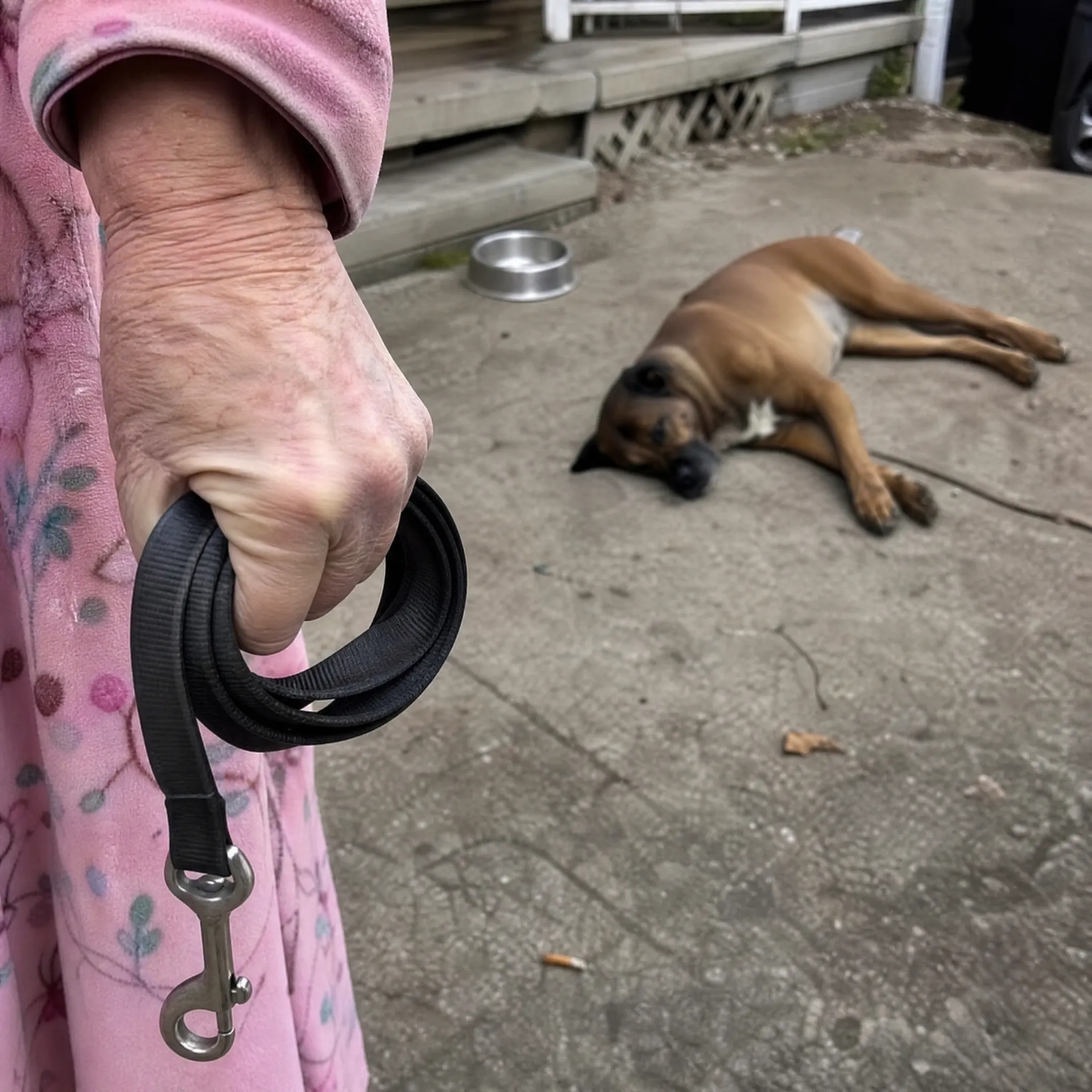
I took a beaten dog to the address on his tag. The woman who answered the door saw him and started crying. Then she told me to take him away and shut the door. I want to tell you about that door, because I stood on the other side of it for about ten minutes with a sixty-pound dog leaning on my leg, and I've thought about it every day since. She opened it a crack. She saw him before she saw me. And the sound she made was not a sound you make about a dog you don't want. It was the sound you make when something you buried comes walking up the steps. She said, "No. I can't." She said, "Take him away." And she shut the door, and I heard her on the other side of it, and the dog heard her too, and he sat down on the porch like he'd been told to wait. I knocked again. I said, "Ma'am, I'm not leaving him on a porch." She opened it again, and she was holding onto the frame with both hands, and she said, "He isn't mine anymore. I signed the paper." I said, "The woman who has him beats him." She didn't say anything for a long time. Then she said one sentence, and shut the door, and I didn't understand the sentence, and I took it for a way of saying never. I'll tell you what it was. Not yet. It'll keep. It kept until the day she said it again, on the same porch, with him in her arms. Let me back up. My name is Terry. I'm fifty-two. I drive a school bus, the same route, twice a day, for nineteen years, which means I know every driveway on the east side of this town by what's parked in it and who comes out to wave. I'm married to a man named Ray who fixes furnaces. We've got two grown kids and a house that's paid for and, as of this spring, a dog we didn't ask for, and I'll get to him. I'm not a doctor. I want that understood before anything else. I got my CDL at thirty-three and that's the extent of my credentials, and what I'm about to tell you I had to look up, word by word, with a dictionary open, over four nights at my kitchen table. But I'm the one who pulled over. That's the only thing I've got that a doctor doesn't, and it turned out to matter. Here's the driveway. It was a Thursday in March, about 4:15, and I was on my way home from the bus barn, and I came around the corner onto Sycamore and there was a woman in a driveway hitting a dog with a leash. Not correcting him. Hitting him. He was on his side and she was still going, and I don't know what I intended to do, but I was out of the car before I'd decided. I said, "Hey. Get your hands off him." She said, "Mind your own business." I said, "You hit him again and I swear to God." She said, "He's not even mine. My daughter dumped him on me from the shelter. He's a dog." And then she said, and I'll give it to you exactly: "You want him? Take him. See how you like it when he pisses all over your floor." And she went in and shut the door, and there was a dog on the concrete with his ribs going, looking at me. I put him in the back seat. He didn't fight me. He put his head on the console between the seats and looked at the road like he'd been waiting for somebody to drive him somewhere, and I sat there with the engine off and thought, Terry, what did you just do. His tag said DUKE. It had a phone number and an address. I called the number from the driveway. Disconnected. The address was 4180 Mill Road, which is out past the reservoir, out where the houses have a lot of yard between them and the mailboxes are all the same brand. I drove out there. I've told you about the door. What I haven't told you is that the woman behind it, whose name is Helen, was seventy-one, and had a walker just inside the door that she'd pushed out of sight when she opened it, and that the yard I was standing in had a tennis ball in it, in the grass, gone gray from the weather, that nobody had picked up in a long time. She wouldn't take him. She said her sentence. I stood there with Duke leaning on my leg and I did the arithmetic that I'd have done about any of the kids on my bus: this dog is not going back to Sycamore, this woman is not opening the door, and I am the one standing here. So I took him home. Ray was asleep in his chair when I came in. It was 5 o'clock. I said, "Ray, it's five o'clock," and he said, "Long week," and I said, "It's Tuesday," which was a joke, because it was Thursday, and because I'd said "It's Tuesday" to him so many times that year it had stopped being a joke. He looked at the dog. He said, "Whose dog?" I said, "We're keeping him. Temporarily." I want to tell you about Ray here, because I didn't know yet that Ray was part of this. Ray is fifty-four. He's been on a cholesterol pill for nine years. Atorvastatin, forty milligrams, one every night with the news. His numbers are, according to his doctor, "exactly where we want them." I fill the organizer. I know the pill. And for about two years I'd been watching my husband disappear a little at a time and telling myself it was the job. The chair by 5. He'd come home from a furnace call and sit down and that was the evening. Asleep by 7:30 with the TV going. The jars. I open them now. I did it once without being asked and he didn't say anything and I didn't say anything and that was that. The stairs to the basement, where his workbench is, which he'd stopped going down. The words. Ray's a talker. Ray tells the same six stories at every cookout and tells them well. And last summer, in the middle of the one about the raccoon in the Hendersons' ductwork, he stopped, and looked at the table, and said, "What was I saying," and somebody said "the raccoon, Ray," and he finished it, and I watched him not tell a story for the rest of the night. And the hand. Flat on his chest, in the chair, in the truck at a red light. Not pain. Just there. I'd told myself all of it. Fifty-four. Furnace season. The knees. If I'd said any of it to his doctor I know what he'd have said, because he's a good man, and he'd have looked at Ray's beautiful number and said: long days, Ray. You're doing everything right. I didn't know yet that I was about to hear that exact sentence about a dead man. I went back out to Mill Road on Saturday. I don't know why. I took the dog. I didn't go up on the porch this time; I let Duke out in the yard, and he went straight to the gray tennis ball, and picked it up, and carried it to the front steps, and lay down with it, facing the door. The door opened. She came out onto the porch with the walker this time, because there was no hiding it, and she sat down on the top step, which took her about a minute, and Duke put the ball in her lap, and she put her hand on his head, and she told me. Her husband's name was Walt. He'd had a stroke in April of last year, in the yard, right there, throwing the ball for the dog. Duke wouldn't leave him. He lay on top of him. The paramedics had to lift the dog off Walt to get him in the ambulance, and Walt died on the way, and the dog stood at the end of the driveway until dark. And in May, she fell. Right there, in the kitchen, and couldn't get up. And Duke stood over her, for two hours, barking at a closed door, until a neighbor heard him. "I was not going to make him do that again," she said. I said, so you gave him up. She said: "I love this dog more than anything else in the world. That's why I gave him away. I couldn't take care of myself anymore, and I had nobody else to look out for him. I couldn't make him go through all of that again." I said, let me bring him back here. I'll walk him every day before work. I'll come by after. I drive past the end of this road twice a day. She said, "Look at me. I can't get down my own front steps. What happens the next time I fall? I'm not doing that to him twice." And that was when I saw the bottle. It was on the little table inside the door, next to the phone, the way people keep the thing they take every day where they'll see it. Orange. I know the label from across a room because I fill one every Sunday. I said, "Atorvastatin. My husband takes these. Same dose." She said, "Walt did. Twelve years. Perfect numbers." And then she said the sentence I've been carrying around ever since, the one I told you I'd hear about a dead man. "His doctor said he'd outlive me." I drove home with the dog and didn't turn the radio on. Twelve years. Perfect numbers. The doctor said he'd outlive her. And he died in the grass with a tennis ball in his hand, and his wife fell a month later and couldn't get up, and she was so sure the same thing was coming for her that she gave away the dog so he wouldn't have to watch it twice. And my husband was asleep in his chair with the same pill on the nightstand. Here's what I did that night, and I want to be honest that it wasn't brave. It was 11 o'clock, and Ray was asleep, and Duke was on the kitchen floor with his chin on my foot, and I opened the laptop and typed the only question I had. Why do people with perfect cholesterol still have strokes? I'm going to tell you what I found, but I want to tell you how I found it first, because it matters. I didn't read a blog. I didn't read a man on a video. I clicked past all of that until I got to the actual medical journals, the ones with the little abstracts and the forty authors, and I read those, and I couldn't understand every third word, so I looked the words up, and I kept going. Four nights. I printed every single one. I circled every claim I'm about to make. The folder is on my kitchen table right now and it's about an inch thick, and if Helen or Ray or you or anybody wants to check me, it's all in there. Read it after I go. I'll tell you what the four nights felt like, because if you've never done it, you should know it's not hard, it's just slow. Night one I learned the word. There's a kind of cholesterol the journals call "oxidized," and they've known about it since the nineties, and there are hundreds of papers, and every one of them says some version of the same thing: it isn't how much you have, it's how much of it has changed. I read that sentence in four different papers by four different groups of people with forty letters after their names, and I sat back in the chair and thought about Walt's doctor telling him he'd outlive his wife. Night two I learned what the pill does and doesn't do, from the pill's own paperwork, which I dug out of the box in Ray's nightstand and read with a magnifying glass. Night three was the part about the muscles, and I had to put the laptop down and go stand in the doorway of the bedroom and look at my husband asleep. Night four was the color. One paragraph. I circled it twice, and then I did the thing I do when I've made up my mind, which is I got thorough. On the fourth night I called Helen. I said, "I can't take him back." She said, "Terry, I've told you." I said, "No, listen. I found something. I think I can fix this." She said, "There's nothing to fix. I can't look after him. Not in my condition. I won't put him through what he went through with Walt." I said, "Then let me come Saturday. I'll bring coffee, a folder, and the dog. You don't have to decide anything. Just read what I found." She said 9 o'clock. I want to tell you what Saturday looked like before I tell you what was in the folder, because the folder doesn't mean anything without the porch. Duke went up the steps first. She was in the doorway. He sat down in front of her and she put both hands on his face and said, "Oh, I'm sorry I put you through all that, buddy," and I stood in the yard and looked at the reservoir for a while. Then we went in, and I put the coffee on her table and the folder next to it, and I said this, which I'd practiced in the car: "Helen, I drive a school bus. I'm nobody's doctor and I'm not going to pretend to be one. So I didn't read opinions. I read the studies. The actual medical journals. Four nights of them. And I printed every one, so you don't have to take my word for anything. It's all in there. Every claim circled. Read it after I go." She opened the folder and looked at the first page, and closed it, and said, "Tell me what it says." So I told her. And I'm going to tell you the same way, in the same order, with the same apple. Cholesterol isn't poison. Your body makes it on purpose, most of it, in the liver. Your brain runs on the stuff. Every cell in you needs it for the walls. It's a building material. The problem was never how much you have. The problem is what happens to it. I said, "You know what rust is?" She said, iron and air. "Iron, air, and time. The same thing happens inside you. The doctors have a word for it. Oxidizing." She said it back. Oxidizing. Like she was writing it down. I'd brought an apple. I cut it on her counter and put half of it on a saucer and we let it sit there while I talked, and by the time I'd finished the next part it had gone brown, and I didn't have to say anything about it. Nobody did anything to that apple. It met the air. When cholesterol meets the air, when it oxidizes, it changes. It stops being a building material and it turns sticky. I'd brought a little honey, too, and I put a drop on her finger and said, feel that. Sticky doesn't float. Sticky grabs. And oxidized cholesterol grabs the wall of your arteries, a little more every year, and packs in, and hardens, and one day a piece of that breaks off and travels, and if it travels up, that's a stroke. "That's what a stroke is, Helen. That's what happened to Walt." She said, "But his numbers were perfect." And here's the sentence that took me four nights to be able to say plainly. The number only counts how much cholesterol you have. It doesn't check how much of it has gone brown. The pill brings the count down. It's very good at that. It doesn't touch the sticky stuff already on the walls, and it doesn't stop the browning. So Walt's chart said fine, right up until the paramedics came. Twelve years of fine. Twelve years of browning. She sat with that. Then she said something I hadn't expected, because it wasn't about Walt. "Since April I'm tired all the time. I drop things. I can't grip a jar. My head's foggy. I don't trust my legs." She looked at the walker. "I thought that was grief." I said, some of it is. Not the hands. Not the legs. Here's the part nobody tells you, and I'd found it in the paper that comes folded up inside the pill box, in print you need a magnifying glass for, and I'd been throwing that paper away for nine years. The pill works by turning off a little switch in the liver. One enzyme. But that same switch, the same line it shuts down to lower your number, is the line your body uses to make the fuel your muscles run on. A thing called CoQ10. Every muscle. Your legs. Your hands. Your heart, which is a muscle, and doesn't get to stop. You can't turn one off without turning the other one down. "That was never grief, Helen," I said. "And it was never age. Nobody checks for it." She looked at her hands on the table for a long time. And there's one more piece, which I'd found on night three and had to read four times. Why the dose creeps up. Why the number keeps trying to come back. When the body's under attack, and browning is an attack, the liver makes more cholesterol to patch the walls. More gets made. More browns. More gets sent. It's a wheel. And the pill grabs the wheel and slows it, and never gets off it, because it isn't built to. So the pill fails twice. It lowers a number that was never the disease. And it drains the fuel you needed to fight the disease that was. And the man taking it feels a little worse every year and is told his chart looks great, and it does, and his doctor tells him he'll outlive his wife. I want to say something about Walt's doctor, and Ray's, because I've thought about them a lot and I'm not angry. They're good. They're kind, and they're tired, and they've got eleven minutes and one number that's easy to measure and one pill that moves it, and a whole system built around that number that would come down on them if they didn't move it. They know about the browning. It's in their own journals; that's where I found it. But knowing a thing and being built to act on it are two different things. There's a five-dollar test for the number. There's no five-dollar test for the brown. So they measure what they can, and they treat what they measure, and they tell a man with a tennis ball in his hand that he's doing everything right. I'm not angry at the cage. I drove past it twice a day for nineteen years. So Helen said the thing you'd say. "Then what do you do about the sticky stuff?" And she got up, and went to the kitchen, and I heard a cabinet, and she came back with two things and set them on the table between us, and this is the part of the story that made me put my coffee down. "Walt knew something was wrong," she said. "He never said it out loud. But he knew." The first thing was fish oil. The big bottle. "Every night with dinner for a year. He took it faithfully. Nothing changed." I said, fish oil isn't wrong. I'd read this on night two. It just floats around outside, in the blood. It never gets inside the cholesterol, where the browning starts. Nothing like it can get in there. And the second thing was a bottle of beetroot capsules. "He ordered them off the computer," she said. "The ones with all the reviews. Months he took those." I want to stop here and tell you what I thought, because I know what you're thinking. I thought, beets. For blood pressure. I'd read that in a magazine in the bus barn. And I thought, that's what Walt was reaching for? A beet? But I'd also read, on night three, one paragraph in one study that I'd circled twice, and it was about the color. So I said, "Can I open one?" I poured a little water in a glass and pulled a capsule apart over it. "Look at that," I said. "What color is that?" She said, "Brown." Real beet pigment, the part that stops the browning, is deep red. Almost purple. It stains. If it's brown, it's dead. It was cooked before it ever went in the capsule. Nearly every powder on the shelf is heat-dried, because heat is fast and cheap, and heat kills the color, and the color is the medicine. And it's the wrong beet anyway. The beet at the grocery store has been bred for sugar and size for a hundred years, and the medicine got bred right out of it. "So he had the right idea," I said. "He had the right idea, Helen. He bought the wrong beet." She said, "I thought beets were for blood pressure." They are. That's the nitrates. That's the part you feel. Twenty minutes after, your blood moves easier, and it's real, and it's why Walt probably felt a little something and kept buying them. But that's not what saves you. The red pigment, the betalains, that's the part that stops the browning. Nitrates move the blood. Betalains stop the rust. Two different things, and the brown capsule had only the first one. She looked at the glass. She said, "Then which one's real?" Here's what I'd done on night four, because I'm the kind of person who reads the whole folder. I went through every beetroot capsule and powder I could find that made any claim about the heart. Nineteen of them. I checked each one against four things the studies were clear about, and I'll give you the four, because they're the whole test and you can run them on any bottle in your house tonight. One: what beet. Not "beetroot." Which strain. If the label doesn't say, it's the grocery beet. Two: how was it dried. If it doesn't say cold, or shade, or raw, it was cooked, because cooking's cheaper. Three: how much, and is it alone. The studies used about thirteen hundred milligrams of the real root. A "proprietary blend" is a pinch of the expensive part in a capsule of the cheap part. Four: where's the lab report. Not the reviews. An outside lab's paper on that batch. Anyone can buy stars. Nobody can buy the lab paper. Almost nothing passed. One did. I'd brought it. I took it out of the folder and set it on the table next to Walt's brown bottle. Rosabella. It's the old heirloom beet. Amish families out in Lancaster County have kept the seed line alive for a hundred and fifty years, never crossed it with the sugar beet. Harvested after the first frost, when the cold pushes the color into the root. Shade-dried, never heated, so the pigment stays alive. Thirteen hundred milligrams, the same dose the studies used, and nothing else in the capsule. And the lab report's posted right on their site. I read that too. I opened one over a second glass. It went crimson from the middle out, dark, like something had been let go in it. Next to Walt's brown one. Helen looked at the two glasses for a long time. Then she said, quietly, "That's what he was trying to buy." And then again, to herself: "That's what he was trying to buy." And then: "How many?" Two capsules, a glass of water, every morning. That's it. I told her what I'd read about expecting it: you'll feel the nitrates inside twenty minutes, and that part's quick, and it's not the proof. The browning part is slow. It shows up in the blood work, in weeks. Don't judge it by a feeling. Judge it by your next test. She said, "And if it doesn't work?" Then it doesn't work. Ninety days, money back, even on empty bottles. I'd called and asked. She laughed, for the first time, a short one. "Nobody at the pharmacy ever offered me that." I left the bottle, the folder, and the dog. Temporarily, we said. Then I went home and did the thing I should have done two years ago. Ray was in the chair. It was 4:40. I put two capsules on the table next to his coffee cup and he looked at them and said, "What is it?" I said, "Beet root. From a small farm in Pennsylvania." And then I said the four words I've never said to my husband about his own health in twenty-six years, because I'd always said everything else: "Take them. For me." He took them. Here's what happened, with dates, because I kept the folder and I started a page at the back. Helen called me eight days later. Sunday morning. She didn't say hello. "I walked to the mailbox," she said. "Then I walked to the corner. I stood there a while, Terry. I just stood there." I said, "That's a good morning, Helen." She said, "It's a start." Ray: the jars, first. On the eleventh day I set a jar on the counter out of habit and he opened it on his way past without looking and I had to go into the laundry room for a minute. Then the chair; he was awake for the end of the game on the 19th, sitting up, and said "huh" at the score like a man who hadn't seen a ninth inning in two years. The basement stairs: I heard the bench light click on a Saturday in May. The story about the raccoon, at the Memorial Day cookout, start to finish, and I watched the people who'd heard it eleven times laugh anyway. And the hand. I caught him at a red light on the way to his mother's, both hands on the wheel, and I didn't say anything, and neither did he. Helen: she called again on a Thursday, three weeks in, and said she'd gone down the front steps without the walker to get the paper, and had stood in the yard afterward, "just to see if I could stand in it." I want to tell you about the bus barn, because it's where I found out this wasn't just Helen and Ray. There are eleven drivers on my shift and a dispatcher named Donna who's been there longer than any of us. We case the routes at a long table at 6 in the morning, and I'd been coming in a little different for a couple of weeks, and Donna noticed, because Donna notices everything. She said, "You've got a spring in your step, Terry," and I said it wasn't mine, it was Ray's, and she wanted to know what that meant. So I did the plate. I'd brought a capsule of Walt's brown ones, which Helen had given me, and one of the other. Two white saucers from the break room, a little water from the cooler, in front of Donna and four drivers and a mechanic who'd come in for coffee. Brown puddle. Crimson bloom. Nobody said anything for a second. Then Donna said, "My Bill's on that pill," and I said, what time is he in his chair, Donna, and she looked at me like I'd read her mail. I asked her the rest. Does he grab the rail. Do you open the jars. Does he lose the words. Is his hand on his chest. Is he up at three. She said, "How do you know about three o'clock?" Nobody had asked her. That's the thing I keep running into, at the barn, on the route, in my own kitchen. Nobody had asked. Bill's doctor looks at Bill's number, and Bill's number is beautiful, and Bill goes home and sits down at 5:30 and Donna decides that's what sixty-three is. She took a picture of the two saucers with her phone. Bill started on a Monday. Three weeks later Donna came in and set her coffee down and said, "He carried the water softener salt down the basement stairs. Both bags. I stood at the top and didn't know what to do with my hands." And there's a mother on my route. I won't say which stop. Her boy's in fourth grade and she walks him to the corner every morning and waits with him, and around March I'd noticed she'd started standing with her hand on the stop sign pole, and then in April she'd started sitting on the retaining wall, and then in May her husband was walking the boy out instead and she was in the window. I know how that goes now. I've watched it go that way in a yard on Mill Road. I didn't knock on her door. I'm not that person yet. But I wrote the four questions on the back of a bus pass and gave it to the boy to give to his mother, with my name on it, and a week later she was at the corner when I pulled up, and she put her hand up like a wave, and it was the hand she'd been keeping on the pole. She's on the pill. Eight years. Her number, she told me through the bus door, is "great." I told her about the apple. She's reading the folder now. I made a second copy. Ray, meanwhile, was doing something I hadn't seen in two years, which was talking to me after 8 o'clock. Not about anything. The Hendersons' ductwork. A furnace out on Route 9 with a squirrel in it. I sat on the couch and let him tell me things I didn't need to know, because for two years he'd gone quiet at 7:30 and I'd told myself that was marriage. On a Thursday in the fourth week he came up from the basement with a birdhouse. He'd built it. He'd had the wood down there since 2022. He set it on the table and said, "For Helen's yard," and I went into the laundry room again. And Helen. She called on a Tuesday, five weeks in, and said she'd been to the grocery store. By herself. With the cart, not the walker. She said she'd stood in the produce aisle looking at the beets, the big red ones in the bin, and had picked one up and put it down again and laughed out loud, and a stocker had asked if she was all right. She said, "I told him I was fine. I told him I was just looking at the wrong beet." And then, six weeks in, she called and said this: "Terry. I think I'm ready to take him back." I'll tell you about the porch in a minute. First the paper, because she'd made me promise to judge it by the paper. Her doctor drew her blood the week before. Total cholesterol 192, down from 245. "These are your best numbers in five years, Helen," he said, and she told me he scrolled the sheet twice and looked at the bottle she'd brought and said, "Whatever you're doing, keep doing it." She said, "I intend to." Ray's doctor, two weeks later: "These are excellent, Ray. Big improvement. Whatever supplement you've added, keep taking it." Ray said, "The wife handles it." He came home and told me the doctor says keep taking it, and grinned, and said, "So you're never hearing the end of this," and I'm not, and I don't mind. Now, the porch. I drove Duke out on a Saturday morning, and I let him out of the car at the end of the driveway, and he went up that yard like a dog going home, and Helen was on the porch, standing, no walker, and she got down on the top step and he went into her arms and she said, "Duke. Duke. Oh, my boy. My boy," and cried into his neck. And then she looked up at me and said the sentence. The one she'd said through the crack in the door in March, the one I'd taken for never. "I told you I'd take him back when I was fit to be seen." That's what she'd said, that first day, when I was standing there with a dog and an address and no idea what I'd walked into. Not never. When I'm fit to be seen. She'd meant it as a promise, and she'd meant it as a goodbye, and she'd meant she didn't think it was possible, and she'd said it to a stranger on her porch because she had nobody else to say it to. She's fit to be seen. She walks him to the corner every morning and back. The tennis ball is not gray anymore, because it gets thrown. I drive these streets twice a day, same houses, same doors, and I think about how close I came to driving past that yard on Sycamore. And I think about Walt's doctor, and Helen's, and Ray's, who are good men who watched a chart. Her doctor watched the chart. Walt's doctor watched the chart. I watched a woman who couldn't get down her own front step to hold her dog. You're the one watching. Whoever you're watching, the chair, the jars, the hand on the chest, the "long week" on a Tuesday. You're closer to the truth than the chart is. You always were. If you want to see the one that passed, it's here: https://track.tryrosabella.com/e73e2b82-57e8-45b3-b98f-f257632c842b I'll tell you what's there so there are no surprises. It's the same bottle from Helen's table. Thirteen hundred milligrams of the heirloom root per capsule and nothing else in it. The strain named. First-frost harvest, shade-dried, never heated, on Plain farms in Lancaster County that have kept that seed for a hundred and fifty years. The lab report for the batch, posted. And you can check it yourself the way I did: open one over a white plate with a little water. Crimson means it's alive. Brown means it's dust. They sell it three bottles at a time, and when you buy three they send three more, which I thought was a gimmick until I understood it. The browning is slow. The proof is in the blood draw, and nobody learns anything in thirty days. Six bottles is a season. It's also how the harvest works, and I'll come to that. And they do the thing nobody at the pharmacy ever offered Helen. Ninety days. If your jars don't come back and your paper doesn't move, you send them the empty bottles, empty, and they send you every dollar. Nobody refunded Walt. Twelve years of copays, a year of fish oil, months of the brown capsule, and a tennis ball in the grass. Nobody has ever offered you that at the pharmacy, and they never will, because the pharmacy isn't in the business of being wrong. Take care of your heart. Not just for you. For whoever's waiting at the door. Terry Bus 14 P.S. If you're on the pill, don't stop it because of anything a bus driver wrote. Ray didn't. Helen's doctor is watching hers. Add, don't subtract, and bring your doctor the lab paper. Ask them to check the part that goes brown, not just the count. Watch their face; I'd bet you'll be the first one who ever asked. P.P.S. You'll feel the nitrates in about twenty minutes. That's real, and it isn't the proof; that's what fooled Walt for months on the brown capsule. Give it three or four weeks for the jars and the chair and the front steps, and a blood draw at ninety days for the browning. Judge it by the draw and the steps. Nothing else. P.P.P.S. Ninety days. Empty bottles. Every dollar. Helen laughed when I told her, and then she took it. P.P.P.P.S. For the wives. He will not do this for himself. Walt didn't; he did it in secret and bought the wrong one. Ray wouldn't have. Put two capsules by his coffee and say, "Take them. For me." It's four words. It took me twenty-six years to say them and about four seconds for him to reach for the glass. P.P.P.P.P.S. On supply. It's about a dozen farms. One harvest a year, after first frost, and it dries in the lofts over a winter, and when the year's crop has been capsuled, that's the year. It isn't on Amazon. If the page is up, there's crop. If it isn't, it's spring. https://track.tryrosabella.com/e73e2b82-57e8-45b3-b98f-f257632c842b P.P.P.P.P.P.S. The gray tennis ball is on my dashboard. Helen gave it to me the day Duke came home; she'd bought him a new one. I look at it at every stop. It's the only thing I've ever kept from a yard I almost drove past. https://track.tryrosabella.com/e73e2b82-57e8-45b3-b98f-f257632c842b
More from The Health Haven
Support stamina and heart health every day
The Health Haven
Support stamina and heart health every day
The Health Haven
Support stamina and heart health every day
The Health Haven
Support stamina and heart health every day
The Health Haven
Support stamina and heart health every day
The Health Haven
Support stamina and heart health every day
The Health Haven
Support stamina and heart health every day
The Health Haven
Support stamina and heart health every day
The Health Haven
Support stamina and heart health every day
The Health Haven
Support stamina and heart health every day
The Health Haven
Support stamina and heart health every day
The Health Haven
Support stamina and heart health every day
The Health Haven

 Add to Chrome