Support stamina and heart health every day
Ad Copy
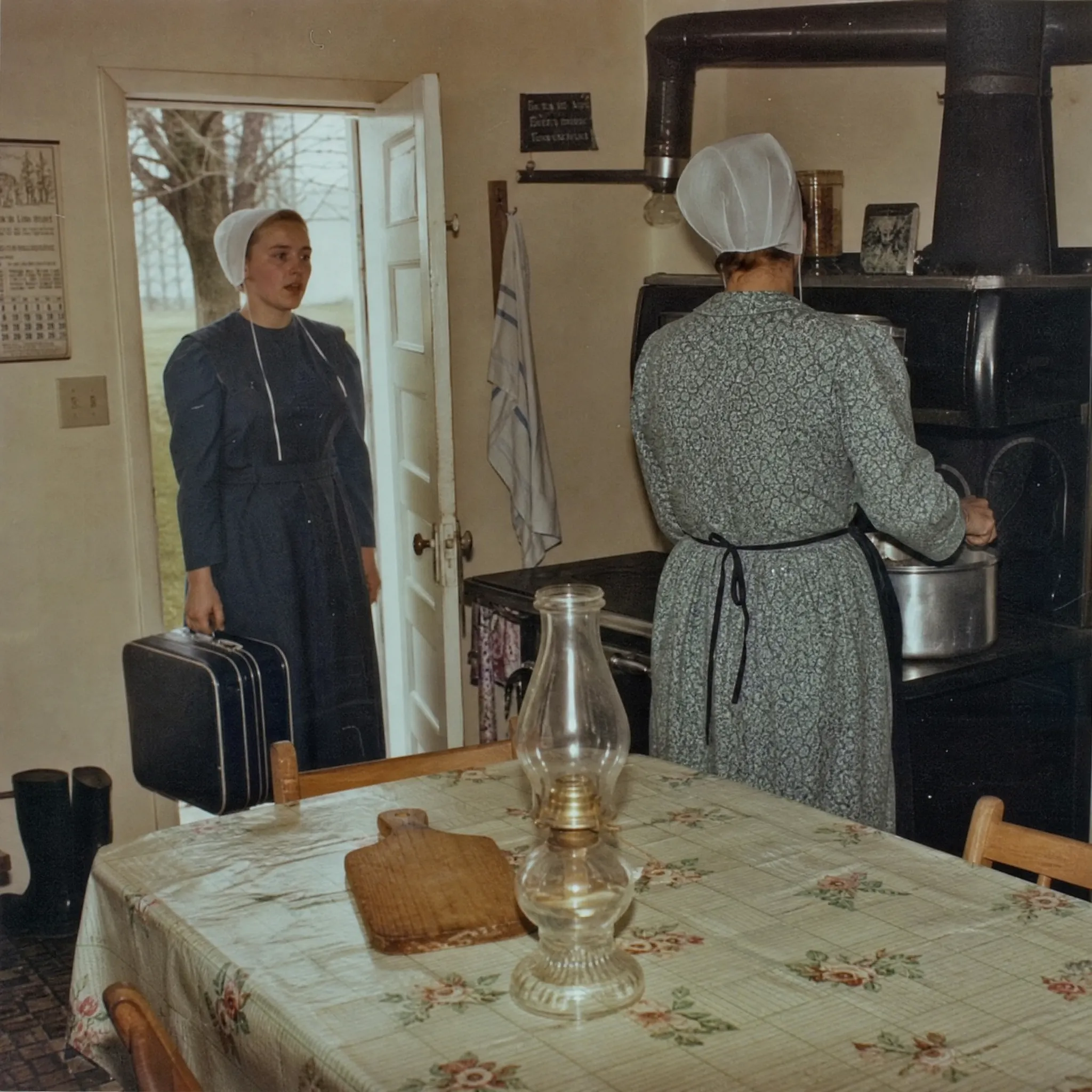
I left the Amish at 20 and became a nurse so I'd never be as ignorant as my parents. At 59 I drove back to their farm to ask my mother a question none of the doctors I work with could answer. I want to be honest about the word "ignorant," because I used it, out loud, to my mother's face, in the spring of 1986, with a suitcase in my hand, and I've had thirty-nine years to think about it. I asked her the question in June. I stood in her kitchen, in scrubs, because I'd driven straight from a twelve-hour shift, and I asked it the way you'd ask a colleague, because I didn't know any other way to ask her anything. She was at the stove. She didn't turn around. She said one sentence, and then she said, "Sit," and I sat, at the table I'd eaten at for twenty years, and she put a plate in front of me the way she used to, and then she answered me. I'll tell you the sentence. Not yet. It's the one thing I've heard in thirty-four years of cardiac nursing that I couldn't chart. It'll keep. It kept since 1986. Let me back up. My name is Esther. I'm fifty-nine. I've been a registered nurse for thirty-four years, all of it cardiac, the last nineteen in the cardiac rehab unit of a hospital in Harrisburg, Pennsylvania, which means that for nineteen years my job has been to take people who've just had a stent or a bypass or a heart attack and walk them, three mornings a week, on a treadmill, with a monitor on their chest, while I chart what I see. I've walked about four thousand people. I know what a heart looks like on a screen the way my father knows what weather looks like on a hill. I'm ordinary otherwise. I'm married to Greg, who teaches driver's ed. We've got three kids and a dog and a split-level with a mortgage. I drive a Honda with 160,000 miles on it. I've been on a cholesterol pill for thirteen years, and my number is 66, and my doctor calls me, and I'm quoting, "textbook," which is a word I've now heard about four generations of people and have stopped being able to hear without flinching. Here's why I left. I grew up on a dairy farm outside Bird-in-Hand, Lancaster County. Old Order. Seven of us. "When I was nineteen my brother Reuben, who was twenty-two, got sick on a Sunday, stomach, and my parents did what my parents did, which was put him to bed and wait and pray and send for the woman down the road who knew things. And on Wednesday, when he was gray and couldn't stand, my father hitched the buggy and drove him to the hospital in Lancaster, and it was his appendix, and it had burst, and he was in the hospital eleven days and nearly died, and the surgeon came out into the hall and said to my father, in front of me, "If you people had brought him in on Sunday, this would have been a two-hour surgery." You people. I decided that day. I decided my parents were ignorant, and that their ignorance had almost killed my brother, and that I would not be ignorant, and that the way to not be ignorant was to go where the surgeon came from. I left the next spring, at twenty, with a suitcase and a GED I'd gotten in secret, and I said the word to my mother in the kitchen, and she didn't answer it, and I went. I wasn't baptized. I wasn't shunned. I could come home. I did, a few times a year, for weddings and funerals and my father's seventieth, and each time my mother fed me and asked if I was well and I said yes, and each time I looked at the kitchen with the wood stove and the lamp and thought: I got out. I went to nursing school on loans. I worked telemetry, then the cath lab, then rehab. I learned everything. I learned the drugs and the doses and the numbers and the guidelines and what the surgeons say in the hall. I became, over thirty-four years, exactly the woman I'd left to become, and I was proud of it, and I'll tell you now what it bought me. I want to tell you about Barb first, because Barb is why I finally asked. Barb Reilly was the charge nurse on my unit for eleven years. She was sixty-two. She'd been on the same pill as me, same dose, for fourteen years, and she was disciplined about it the way nurses are, because we know better. Her LDL in April was 63. She'd told me, at the nurses' station, holding the printout, "Sixty-three, Es. If I were my own patient I'd discharge me." She died on June 3rd, in the med room, at 6:50 in the morning, drawing up a heparin flush. I was the one who found her. I coded her for eleven minutes with two other nurses before the team got there, and I want you to understand what that means: I have coded four hundred people. I know when it's over. It was over before I got to her. Massive anterior infarct. The kind we call a widowmaker. Her husband Ken said the thing at the funeral. He said, "Her cardiologist told her in April she was the healthiest sixty-two-year-old he had. He said that. The healthiest." I went back to work on Monday and walked eight people on the treadmill and charted what I saw, and what I saw, on the eighth one, was a man of sixty-eight with an LDL of 61 and a new stent who told me, when I asked how he was doing at home, that he was "in the chair by 7:30 and can't open a jar," and I charted what I have charted about a thousand times for that answer, which is the word "deconditioning." And I stopped, with my pen on the page, and thought: Barb was in the chair by 7:30. She'd told me. I'd told her it was the shifts. Here's the year I'd been having, which I hadn't charted, because the chart was for other people. The stairs from the parking garage to the unit. Three flights. I'd started taking the elevator in 2024. I told myself it was the bag. The jar. Greg opens them. He did it once without being asked and neither of us has said anything since. The chair by 7:30. Asleep in it by 8:15 with the news on. Awake at 3:10, every night, lying there with my hand flat on my chest. Not pain. Checking. I know exactly what I'm checking for. I've spent thirty-four years watching it on a screen. And the words. This is the one. I give handoff report every shift, drug names, doses, forty patients' worth, and I've done it ten thousand times. And in May, in report, I lost "metoprolol." Not the patient. Not the dose. The word. I stood there with the sheet and said "the, the beta blocker, the," and the night nurse said "metoprolol, Es," and I said yes, and finished report, and went into the supply closet and stood there. And the hand. I caught it in the elevator mirror on the way down to the garage, flat on my sternum, the way you'd rest it on a monitor to feel it hum. I'd told myself all of it. Fifty-nine. Nineteen years of twelve-hour shifts. Barb. Grief. And I knew exactly what my doctor would say, because I've said it, in that unit, to a thousand people, kindly: your numbers are textbook. It's deconditioning. We'll get you walking. Barb's numbers were textbook. So I did the thing I'd been trained to do, which is ask the doctors. I work with four cardiologists. I've known two of them for fifteen years. And over the next two weeks I asked each of them, in the hall, at the station, the same question, and I'm going to give it to you exactly, because it's the question in the first line of this letter. "Why do people with perfect cholesterol keep ending up on my treadmill?" Dr. Hammond said "residual risk," which is the phrase, and I know it's the phrase, because I've used it on families, and it means "we don't know." Dr. Patel said "genetics, mostly," and then, because she's honest, "and some things we don't measure." Dr. Okonkwo said the guidelines are the guidelines and the numbers are the numbers and he'd rather have the numbers than not. And Dr. Reese, who's the oldest, who's been doing this longer than I have, looked at me for a long time and said, "Esther, if I knew that, I'd be out of a job," and it wasn't a joke, and he knew it wasn't, and he walked away. Four cardiologists. Four answers. Not one of them was an answer. And on Thursday, June 26th, at the end of a twelve, standing in the garage with my hand on the car door, I did the arithmetic I'd been refusing to do for thirty-nine years. Barb: fourteen years on the pill, 63, dead at sixty-two. Me: thirteen years on the pill, 66, fifty-nine. My mother: never a pill. Eighty-four. Still, according to Reuben, canning two hundred quarts a summer and walking to the neighbors' for church. My father: never a pill. Eighty-seven. Still milking. And I got in the car, and I did not drive to the split-level. I drove east, on 283, in scrubs, to Bird-in-Hand, to the kitchen I'd said the word in. I told you about the stove. She was at it. It was 7:40 and still light and she was putting up beans, and she didn't turn around when I came in, and I stood there, and I asked her the question the way I'd asked four cardiologists, because I didn't have another way. "Mem. Why do people with perfect cholesterol keep dying?" She said her sentence. And then she said, "Sit." I want to give you what she told me the way she told it, in a kitchen with a wood stove going in June, with her back to me for most of it and a canning pot boiling, because a woman with an eighth-grade education explained my entire field to me in the time it took her to do a batch of beans, and she did it in the language of the thing she was doing. She said, "What does your pill do." I said it lowers the amount of cholesterol in the blood. She said, "And too much of it is what kills them." I said that's the model. That's what we're taught. She set a jar on the counter, one she'd just pulled from the pot, and she set a second one next to it from the shelf, one that had been opened, applesauce, with the top gone brown the way applesauce does in an open jar. "Same amount in both," she said. "Which one would you eat." The sealed one. "Why." Because the other one's turned. "Did it turn because there was too much applesauce in it?" No. "Then your pill's counting the jars," she said. "It's not checking the seals." Here's the science, in my words now, which are a nurse's words, and I've spent every night since with the journals and I'm ashamed of how many I already had access to and had never read. Cholesterol isn't poison. Your body makes it on purpose, most of it, in the liver, because it needs it. It's a building material. Your brain is mostly made of it. Every cell wall in you needs it. It's what's in the jar. There's nothing wrong with what's in the jar. The trouble is the seal. Cholesterol in the blood can oxidize, and oxidize is just the chemist's word for what happens to applesauce in an open jar, or an apple on the counter, or butter on the sill. The air gets to it. Nothing got added. The material turned. When cholesterol turns, it changes. It stops being a building material and becomes something the body treats like an injury. It gets sticky. The body sends cells to clean it up and they get stuck to it, and it packs into the wall of the artery, year after year, and hardens. That hardened, turned mess is the plaque. I've looked at it on a screen four thousand times. When a piece of it cracks off, that's the heart attack. That's the med room at 6:50. The pill lowers the number. It's very good at that. It counts the jars and takes some off the shelf. It does not touch the turning. It doesn't check a single seal. "Barb had fewer jars," my mother said, not turning around. "They'd all turned anyway." Fourteen years of 63. Fourteen years of open jars. And then she did turn around, and she looked at my hands, which were on her table, and she said the thing that turned it from Barb's story into mine. "And a tired woman turns faster." I've checked this. It's in the package insert. I have handed that package insert to patients for thirteen years and never once read past the dosing. The pill works by shutting off a switch in the liver. One enzyme. It's a clean target and it works. But that same switch, that same production line the pill shuts down to lower the number, is also the line your body uses to make a thing called coenzyme Q10. CoQ10 is the spark. It's what every muscle cell in you uses to turn fuel into work. Your legs. Your hands. Your heart, which is a muscle, and I have watched it not get to stop on a monitor for thirty-four years. You cannot turn down one without turning down the other. One switch, two flows. And so a nurse takes the pill for thirteen years and takes the elevator, and loses "metoprolol" in report, and charts "deconditioning" on a thousand people who are describing her own year back to her. That part was never age. Nobody checks. I didn't check. I had the clipboard. And the last piece, which my mother got to while the beans were sealing. Why the dose creeps up. Why the number keeps trying to climb and we keep turning the dial. When the body's under attack, and the turning is an attack, the liver makes more building material to patch the walls. More gets made. More turns. More gets sent. It's a wheel. The pill grabs the wheel and slows it and never gets off, because it isn't built to. Her version: "You're bailing the boat, Esther. Nobody's found the hole." So the pill fails twice. It lowers a number that was never the disease. And it drains the spark you needed to fight the disease that was. And the woman taking it feels worse every year, and her chart looks better every year, and one morning she goes into the med room to draw up a flush. I want to say something about my four cardiologists, and about myself, because it would be easy to make them the villains, and I've worked beside them for fifteen years and I won't. They're good. They're kind, and they're tired, and they've got eleven minutes and one number that's easy to measure and one pill that moves it, and a whole system built around that number that would come down on them if they didn't move it. They know about the turning. It's in their own journals. Dr. Reese said it to my face: if I knew that, I'd be out of a job. But knowing a thing and being built to act on it are two different things. There's a five-dollar test for the number. There's no five-dollar test for the seal. So they measure what they can, and they treat what they measure, and they tell a charge nurse she's the healthiest sixty-two-year-old they've got. I'm not angry at the cage. I've been the cage. I'm the one with the pen who wrote "deconditioning" a thousand times. So I asked my mother what she'd been doing for eighty-four years that four cardiologists hadn't. She went down the cellar stairs, slowly, and came back up with a crock, the stoneware kind, and set it on the table between the two jars, and took the lid off, and took a pinch of what was in it, dark and dried and crumbling, and put it in my hand the way she used to put a piece of bread in it. "Since before you were born," she said. "Every morning. A pinch in water. Your father too." It was a beet. Now, I want to stop, because I know what a cardiac nurse thinks when she hears that word, since I was thinking it. I have been telling rehab patients to drink beet juice for blood pressure for nineteen years. Nitrates. It's in our handout. There's a sample packet of beet powder in the rehab kitchen that a rep left, pink, four and a half stars on the box, and I'd been putting it in water myself, three mornings a week, for two years. For my pressure. Same reason I told patients to. I had a packet in my scrubs pocket. I put it on the table. My mother opened it, smelled it, put a finger in it and tasted it, and folded it closed. "Zucker," she said. Sugar. "That's a cattle beet. Somebody grew that for weight." And then she did a thing I have since done on the counter of the rehab kitchen in front of Dr. Patel, and at Ken Reilly's counter, and at the nurses' station on a Tuesday night in front of six nurses who don't believe anything they can't see on a monitor, and that I want you to do tonight before you decide a nurse has lost her judgment. She took a saucer, put the pink powder on it, and poured a little water from the kettle. It went brown. Not red. Brown, the color of a puddle in a gravel lane. It sat there. Then she took a pinch from the crock and did the same thing on a second saucer. It bloomed. There's no other word. The water went crimson from the middle out, dark and alive, like something had been let go in it. "That's the color," she said. "The color's the medicine. Heat kills it. Sun kills it. The sugar beet never had it. You've been giving your patients the wrong beet, Esther, and taking it yourself." Here's the science of the color, because it has a name, and I have now read it in eleven journals, three of which are on the shelf in our own break room. The red in a true beet is a family of pigments called betalains. They're not the nitrates. Nitrates are the part in our handout, the blood-pressure part, the part that opens the vessels twenty minutes after a glass. That's real. That's what I'd been feeling from the packet and it's why I thought it was doing something. Betalains are the part that stops the turning. They're some of the strongest antioxidants ever measured in a food, and they work inside the cholesterol particle itself, where the seal breaks, which is the one place a statin never goes and the fish oil in half my patients' bags floats right past. Nitrates move the blood. Betalains stop the rust. Two different things doing two different jobs, and only one of them was in the rep's packet. And betalains are fragile. Heat wrecks them. Light fades them. And the big, sweet, red beet at the grocery store, and the powder made from it, was bred over a century for sugar and size and shelf life, and the betalains were bred right out. When you cook that beet and spray-dry it and cut it with something to make it cheap, what's left is the nitrates and a color like a strawberry milkshake and none of the part that would have kept Barb out of the med room. She told me the rest while she wiped the counter, which is the part I hadn't expected. The beet in the crock is an old German root, Blutwurzel, blood root, and the seed has been saved by hand in that garden since before the Civil War and never crossed with the sugar beet, because my mother is not, as she puts it, in the habit of being talked into things. For most of my life the family ate it and the surplus went to the market. Not anymore. For the last several years the surplus from that garden, and from about a dozen Plain farms in the county that trace their seed to the same old lines, gets bought, every autumn, by one buyer, and they'd been, my mother said, "particular about four things," and she told me the four, and I wrote them on the back of a rehab treadmill log, and they're the whole test. One: what beet. Not "beetroot." Which strain, and has it ever been crossed with a sugar beet. If the label doesn't say, it's the cattle beet. Two: how was it dried. Heat kills the color. If it doesn't say cold, or shade, or raw, it was cooked, because cooking's cheaper. Three: how much, and is it alone. The studies that matter used real doses of the real root, around thirteen hundred milligrams. A "proprietary blend" of beet plus eleven other things is a way of putting a pinch of the expensive part in a capsule of the cheap part. A blend is where the truth goes to hide. Four: where's the paper. Not the reviews. An outside lab's report on that batch. Anyone can buy stars. Nobody can buy the lab paper. I asked my mother how a woman in a split-level in Harrisburg with no cellar gets that beet. And she got up, and went to the cabinet over the sink, the one that in thirty-nine years I had never once seen anything in but a box of matches and my father's reading glasses, and she took down a bottle, and set it on the table between the crock and the packet. My mother, who has never taken a pill in her life, had a bottle in the cabinet. "For the winter," she said. "When the crock runs low. Reuben gets them from the English company that buys the surplus." Rosabella. I turned it over the way I'd turn over any bottle in the med room. The strain on the label, the same word she'd used. First-frost harvest, shade-dried, never heated. Thirteen hundred milligrams and nothing else in the capsule. A batch number, and a website where the lab report for that batch was posted, which I pulled up on my phone, in a kitchen with a wood stove, while my mother put the kettle back on. I ordered seven others that week anyway, because I'm a nurse and I don't take one saucer's word for anything. I lined them up on my counter and did the saucer, one at a time, with Greg watching. Six of the seven went brown. One bloomed. It was the one from my mother's cabinet. Here's what's happened since, with dates, because I chart for a living and I've started a chart on myself. I started on June 30th. Two capsules in the morning with water. I did not stop my pill. I want that understood in the plainest terms a nurse can put it: nobody should stop a medication because a nurse wrote something on the internet. What I did is what I'd want any patient of mine to do: I added the thing that does the half the pill doesn't, and I let my own doctor watch. The nitrate feeling came in half an hour, same as the packet. I noted it and ignored it. It's not the proof. I've charted that feeling on a thousand people and called it progress. The first real thing was the garage stairs. On July 22nd I got to the unit and realized I hadn't taken the elevator. I stood at the door with my badge and checked. I'd been taking the stairs for about a week without deciding to. "Metoprolol" came back. I gave report on the 30th, forty patients, every drug, and didn't brace for a single one, and the night nurse, who knew, said "nice" under her breath. The chair moved. I'm in it now, at 10:40, writing this, and Greg's asleep, and I'm not tired, and that would have been unthinkable in May. The 3:10 thing stopped in the fourth week. I can't give you the night. I was asleep. And the hand. I caught myself in the elevator mirror on August 8th with both hands on the strap of my bag and realized it was the first time I'd seen them there in a year. Then the paper. I asked Dr. Ruiz, my own doctor, to run something she'd never run on me and I'd never ordered on a patient in thirty-four years: oxidized LDL. The turning itself, measured. My number in June, the week of Barb, was 79. On the pill, with a 66. On August 4th: 61. On August 25th: 66, up, which is what real biology does and what a fake result never does. On September 15th: 47. My LDL, for the record, is 66. It hasn't moved. The pill did its job. The pill was never the story. Dr. Ruiz scrolled through the sheet twice. She looked at the bottle. And she said the thing I have said to a thousand people on a treadmill, except that she said it looking at a number that had never moved before: "Whatever you're doing, keep doing it." And she wrote the name on her pad. Her own pad, not my chart. I've watched a lot of doctors write things down. Greg started July 3rd, at sixty-one, on the same pill I'm on, and on August 16th he carried the kayak down to the water at Pinchot by himself, which he hasn't done since 2022, and stood on the bank looking at his own arms. I did the saucer at the nurses' station on a Tuesday night in August, at 3 AM, because that's when nurses talk, with the rep's packet and my mother's crock, in front of six nurses. Brown puddle. Crimson bloom. Nobody said anything, which at a nurses' station is a long time. Then Dee, who's been on nights for twenty years and on the pill for ten, leaned over the saucers and said, "Es, that's oxidation," like she was reading a lab value. I said yes. She said, "In us." I said in all of us. She asked me what the four questions were and wrote them on her hand. And then I did it in the rehab kitchen, on a Thursday, in front of Dr. Patel, who is honest, and who watched the two saucers and said, "Where did you get the red one?" and I said my mother's cellar, and she said, "Your mother's Amish," and I said yes, and she was quiet, and then she said, "Some things we don't measure," which is what she'd said in the hall in June, except that this time she was looking at one of them. And Dr. Reese. I didn't do the saucer for Dr. Reese. He found it. He came into the rehab kitchen on a Friday looking for coffee and the two saucers were still on the counter from the morning, one brown, one red, and he stood there with his cup and looked at them for a long time, and then he looked at me, and I told him. The crock. My mother. The four questions. The sheet with my numbers on it, which I'd been carrying in my scrubs pocket for three weeks like a teenager with a note. He read the sheet. He's sixty-eight and he's been reading lab sheets since before I was a nurse, and he read mine twice, and then he said, "Who ordered the ox-LDL?" I said I'd asked for it. He said, "In thirty-one years, Esther, I've ordered that twice." And he set his coffee down, and said, "Both times I didn't know what to do with the result." And then, quieter: "So I stopped ordering it." That's the cage, in one sentence, from the man who's been in it longest. He knew the test existed. He knew what it measured. He didn't have anything in the building for the answer, so he stopped asking the question. And he'd told me in June, in the hall, if I knew that I'd be out of a job, and he'd known, and he'd meant the second half. He asked me where the bottle came from. I told him. He wrote it on his hand. And the man with the 61. His name is Walt, and he's the one I charted "deconditioning" on, the Monday after Barb. He's sixty-eight, he's got a new stent, and he'd been walking my treadmill three mornings a week for six weeks going nowhere, which happens, and I'd been writing it down. In July I asked him the list instead. He had every item. When I got to "is your hand on your chest," he looked down at it, on his chest, and said, "Nobody's ever asked me that. They just look at the number." I did the saucer for him, on the counter, with his wife watching. He started on July 9th. On August 20th he got off the treadmill at the end of his thirty minutes and, instead of sitting down in the chair by the door the way he'd done for ten weeks, he walked over to the window and stood there looking at the parking lot, and his wife looked at me, and I looked at the chart, and for the first time in nineteen years I didn't know what to write, because there isn't a word for a man standing at a window when he could be sitting. So I wrote that. "Standing at the window." It's in his chart. And I've started doing something on the treadmill that I've never done in nineteen years, and that I'm going to keep doing. When a patient tells me he's in the chair by 7:30 and can't open a jar, I don't write "deconditioning." I ask the rest. Are your legs heavy on the stairs. Does somebody else open the jars. Do you touch the rail. What time are you in the chair. Do the words go. Is your hand on your chest. Are you awake at three. I've asked it of forty-one patients since July. Every one of them had every item. Every one of them looked at me the way you'd look at someone who'd read your mail. And every one of them said some version of the thing the man with the 61 said to me on July 9th, which is why I'm writing this: "Nobody's ever asked me that. They just look at the number." And Ken. Ken Reilly is on the same pill Barb was. Same dose. His doctor put him on it after the funeral "as a precaution," and he'd been in his chair by 7:30 since June and had decided that was widowhood. In August I sat at his kitchen table, where Barb's printout was still on the refrigerator under a magnet, sixty-three, and I asked him the list. He said, "Es, who told you about three o'clock?" And then he said the thing I can't stop hearing. He said, "Barb was in that chair by 7:30 for three years. I opened her jars. She'd lose a word and I'd hand it to her. I never said anything, because she was a nurse. She'd have known." He said, "She'd have known, Es. Wouldn't she?" She didn't know. I didn't know. Four cardiologists didn't know. My mother knew, in a kitchen with no electricity, and I'd called her ignorant with a suitcase in my hand. Ken started August 12th. On September 20th he called me to say he'd cleaned out Barb's side of the closet, all of it, in one afternoon, by himself, and had to sit on the bed when he was done, "but not because of my legs. Because I couldn't remember the last time." The doctor watches the chart. I watched the chart. I had the clipboard for nineteen years and wrote down what the chart said instead of what the person on the treadmill was telling me. You're the one watching. You're closer to the truth than the chart is. You always were. I wasn't, and I'd left home to be. If you'd like to run the four questions yourself, or start where my mother's cabinet starts, it's here: https://track.tryrosabella.com/e73e2b82-57e8-45b3-b98f-f257632c842b I'll tell you what's there so there are no surprises. It's the same bottle from over my mother's sink. Thirteen hundred milligrams of the heirloom root per capsule, nothing else in the capsule. The strain named. First-frost harvest, shade-dried, never heated, on Plain farms in Lancaster County that have kept that seed since before the Civil War. The lab report for the batch, posted. And a saucer test you can do on your own counter, in thirty seconds, against whatever packet is in your pocket. They sell it three bottles at a time, and when you buy three they send three more, which I assumed was a gimmick until my mother explained it. The turning is slow. The proof is in the blood draw, and nobody learns anything in thirty days. Six bottles is a season. It's also the harvest math, and I'll come to that. And they do something I have never seen in thirty-four years of a business that is, at bottom, about the things people pay for and never get back. If you take it for ninety days and your stairs don't come back and your paper doesn't move, you send them the empty bottles, empty, and they send you every dollar. I called. The woman said the empties are the point; it means you took it. I thought about that for a while. Nobody refunded Barb. Fourteen years of copays, and "the healthiest sixty-two-year-old I've got." Nobody has ever offered you that at the pharmacy, and they never will, because the pharmacy isn't in the business of being wrong. Neither, I'm sorry to say, was I. Now, the sentence. I stood in my mother's kitchen in June, in scrubs, and asked her, the way I'd asked four cardiologists, why people with perfect cholesterol keep dying. And she didn't turn around from the stove. She said: "You could have asked me at twenty. You told me instead." That's it. That's what she'd been carrying since 1986. Not the word I'd said. The fact that I'd said it instead of asking. I'd stood in that kitchen with a suitcase and told a woman who'd been checking seals for sixty years that she was ignorant, and gone off to learn the number, and she'd let me go, and fed me every time I came back, and waited thirty-nine years for me to walk in and ask her a question. She'd have told me at twenty. She'd have told Barb. She'd have told the four thousand people I walked on a treadmill. Nobody asked. We told. Reuben's appendix, by the way. I asked her about that, too, finally, at the table. She said my father had sent for the English doctor on Sunday night, and the doctor had said it was the flu and to wait, and my father had waited, because the doctor said so, and driven to Lancaster on Wednesday when the waiting was over. I'd built a life on a story I'd gotten wrong at nineteen in a hospital hallway. I'm not going to make more of that than it is. I'm just telling you I'd gotten it wrong. I drive out on Sundays now. In scrubs, sometimes, if I've come off a shift. My mother puts a plate in front of me, and I help with whatever's on the stove, and we don't talk about 1986. She's eighty-four. She showed me how to check a seal last week, which I'd forgotten, and I let her. Esther Kline, RN Harrisburg, by way of Bird-in-Hand P.S. If you're on the pill, don't stop it because of anything a nurse wrote. I didn't. Greg didn't. Ken didn't. Add, don't subtract, and let your own doctor watch. Bring them the lab paper. Ask them to run oxidized LDL. Watch their face; I've stood next to four cardiologists and I'd bet you'll be the first patient who ever has. P.P.S. You'll feel the nitrates in about twenty minutes. That's real, and it isn't the proof; that's the handout feeling, the one I charted as progress for nineteen years. Give it three or four weeks for the stairs and the chair and the 3 AM, and a blood draw at ninety days for the turning. Judge it by the draw and the stairs. Nothing else. P.P.P.S. Ninety days. Empty bottles. Every dollar. I've never seen anyone offer it and I'd take it before they think better of it. P.P.P.P.S. For the wives, and the husbands, and anyone who's been handing a person the word they lost and calling it age. She will not do this for herself, and neither will he. Barb was a nurse and didn't. Put two capsules by the coffee and say, "Take them. For me." Ken says he'd have said it in 2022 if anyone had asked him one question. P.P.P.P.P.S. On supply. About a dozen farms. One harvest a year, after first frost, and it dries in the sheds over a winter, and when the year's crop has been capsuled, that's the year. It is not on Amazon, and my mother wouldn't sell to them if they came up the lane. If the page is up, there's crop. If it isn't, it's spring. https://track.tryrosabella.com/e73e2b82-57e8-45b3-b98f-f257632c842b P.P.P.P.P.P.S. There's a jar of my mother's applesauce on my counter next to the bottle. Sealed. I check the seal every morning before I take the capsules, which is a silly thing for a nurse to do, and I'm going to keep doing it, because for thirty-nine years I counted jars for a living and never once checked one. https://track.tryrosabella.com/e73e2b82-57e8-45b3-b98f-f257632c842b
More from The Health Haven
Support stamina and heart health every day
The Health Haven
Support stamina and heart health every day
The Health Haven
Support stamina and heart health every day
The Health Haven
Support stamina and heart health every day
The Health Haven
Support stamina and heart health every day
The Health Haven
Support stamina and heart health every day
The Health Haven
Support stamina and heart health every day
The Health Haven

Support stamina and heart health every day
The Health Haven
Support stamina and heart health every day
The Health Haven
Support stamina and heart health every day
The Health Haven
Support stamina and heart health every day
The Health Haven
Support stamina and heart health every day
The Health Haven

 Add to Chrome