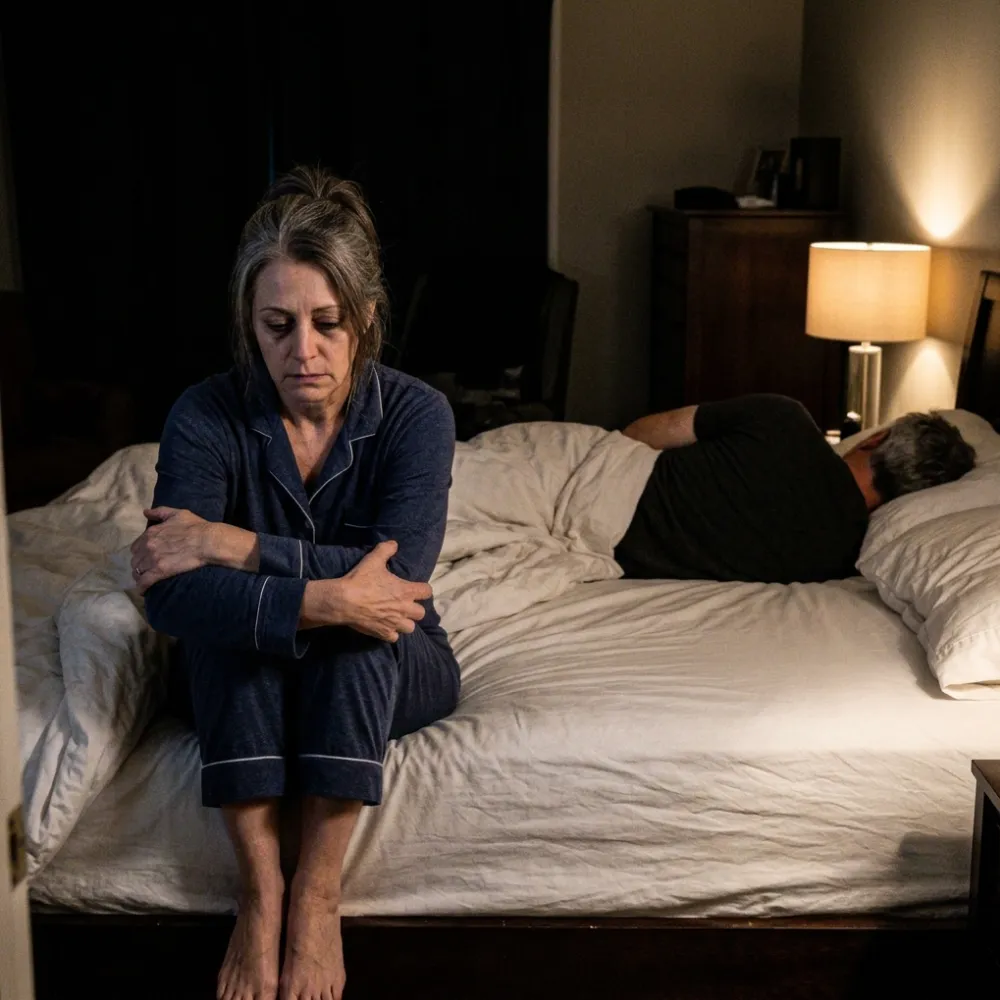
Painful sex after menopause is not just in your head
Ad Copy
A man once told my patient that a wife who cannot have sex deserves to be cheated on. She was 54. She was not cold. She was in pain. I have been a women's health practitioner for a long time, and I have heard a lot of cruel things said to women. That one stayed with me. She had come to me months earlier and said sex had started to hurt. Really hurt. She had stopped reaching for her husband, not because she stopped loving him, but because she was bracing herself every single time. Her own doctor had waved it off. "That's just menopause." Sent her home with nothing. So she did what most women do. She bought lubricant. Then a different lubricant. Then a third one that promised the world. None of it touched the real problem. And while she was quietly fighting this alone, her husband decided her body was an inconvenience he did not have to be loyal to. I want to tell you what I told her, because if sex has become painful since menopause, no one has probably explained what is actually happening inside your body. And once you understand it, everything about how you have been trying to fix it starts to make sense. Here is the part no one says out loud. When estrogen drops in menopause, the tissue down there does not just feel dry. It changes. It gets thinner, less elastic, less cushioned, with less blood flow reaching it than before. There is a name for it. It is called vaginal atrophy, and it affects up to half of women after menopause. Half. And almost no one talks about it. So let me say the thing your doctor rushed past. You are not broken. You are not frigid. You are not "just getting old." Your body went through a real, physical change, and you were handed a tube and sent away. I have lost count of how many women have said a version of the same sentence to me. "I am 50, not dead." They are right. They are still here. They still want to feel like themselves. And they were made to feel like asking for that was somehow greedy. That is the part that makes me angry, even now. Not the biology. The dismissal. A woman tells the truth about her own body and gets a shrug and a brochure. Now, here is why the tube was never going to be enough. Lubricant works on the surface. It reduces friction for an hour. That is all it was ever designed to do. But the change happening in menopause is not on the surface. It is underneath, in the tissue itself. Think of a houseplant that is wilting. You can pour water over the leaves all day. If the roots are starving, the plant still dies. The leaves were never the problem. That is what lubricant is. Water on the leaves. The tissue underneath is still starving, and no amount of lube reaches it. A lot of women get sent one step further, to estrogen cream. And for some it helps. But here is what often gets left out of that conversation. The cream mostly works where you put it, near the surface. The deeper layers, the ones that lost cushioning and blood flow, are harder to reach that way. Which is why so many women tell me they used a cream faithfully for months and still felt the same pain. And then there is a whole group of women who are told they cannot use hormones at all. Breast cancer survivors. Women with clotting risks. They are often left with the worst version of the advice: just live with it. I refused to keep telling women to just live with it. There is also a piece of this that has nothing to do with the tissue at all, and it matters just as much. Desire does not only live below the waist. It lives in the nervous system. When a woman has been run down, stressed, and depleted for years, the body reads that as not safe, not now, and it quietly turns desire down to protect her. Menopause stacks on top of that. So you end up with two things happening at once. The body changed, and the want got switched off. That is why a fix aimed only at the surface always feels incomplete. It is solving one half of a problem that has two halves. So I started looking at the other side. Not masking it from the outside, but supporting the body from the inside. Naturally. Without synthetic hormones. Three things kept coming up in that work. Shatavari, a botanical used in women's health for centuries, that works through the body from the inside rather than only on the surface. Shilajit, a mineral rich compound that carries trace minerals the body draws on for cellular energy, the kind of deep depletion that menopause leaves behind. And saffron, which has been studied for female desire and mood, the part of intimacy that is not physical at all but disappears right alongside the physical. I am careful with my words here, so let me be honest with you. I am not telling you a gummy rebuilds tissue or cures anything. It does not replace hormones, and it does not replace your own doctor. What I can tell you is what I see, and what women themselves report back to me. When desire is supported from the inside instead of forced, intimacy stops feeling like something to brace against. It starts feeling like something they want again. That shift is real, and for a woman who had given up on it, it changes everything. Now, I know what some of you are thinking, because the most honest women say it straight to my face. "I have already spent money on things that did nothing. Why would this be any different." I understand that guard completely. You should have it. Here is the honest answer. Most libido products try to stimulate a system that has been switched off. They push it. For a night you feel something, then you are right back where you started. This is the opposite idea. It is about restoring what got depleted, slowly, so the wanting can come back on its own instead of being forced. That is also why it is not an overnight thing. Anything that promises you fireworks tonight is not being straight with you. How you take it matters too, so let me be plain about that. One gummy, every day, at roughly the same time. Not only on the nights you are hoping something might happen. The whole point is that the body is being topped back up steadily, and steady only works if it is daily. Give it the full stretch of weeks before you judge it. The women who quit at week two almost always quit the week right before the part they had been waiting for, and that breaks my heart every time. Set a small reminder on your phone if you need to. Treat it like the one promise you are finally keeping to yourself this year. There is a survey from the brand I will mention in a moment where 89 percent of women said low desire was damaging their confidence and their relationships. That number did not surprise me at all. It is the quiet part of this that quietly wrecks marriages, and it almost never gets named. I also kept noticing a pattern with the popular libido supplements. Women would say the same thing. A little more spark, maybe, but the dryness was still there, still something they had to manage on their own, separately, forever. The arousal and the comfort were being treated as two different problems by products that only ever solved half of it. And the cost of that missing half is not small. The husbands who write to me, and they do write to me, almost never say they feel rejected because they are not getting sex. They say they feel rejected because they have watched the woman they love slowly disappear, and they spent years assuming it was something about them. It was not. It was biology no one bothered to explain to either of you. That is the real wound here, the one sitting underneath the physical one. It runs in both directions, it gets worse in silence, and a tube of lubricant was never going to close it. The version I now point women toward is from a small company called Bloomin. They combine those three ingredients into one berry gummy you take once a day. No prescription. You chew it, which most women find a lot easier than swallowing another pill on top of everything else they already take. I started suggesting it, alongside proper care, to women who came in describing exactly what I described to you above. What they tell me, weeks later, lands in roughly the same order every time. In the first week, most do not feel much. I tell them that is normal and to keep going. This is restoration, not a switch you flip, and the body takes a little while to trust that the depletion is being topped back up. Somewhere in week two or three, the mood lifts first. They describe feeling a little more like themselves. Less flat. A flicker of interest that had been gone for years. Sleep is often a touch better too, which catches them off guard. By week four or five, the sentence I hear most is some version of this. "I actually wanted him again. I initiated, for the first time in I cannot remember how long." And by week six or so, for the ones who stay with it, the thing they describe is not really about sex at all. It is that they stopped feeling like a stranger in their own body. The dread went quiet. They felt like a woman again, not a list of symptoms. That patient I told you about at the start, the one whose husband said that unforgivable thing, came back to me about two months in. She did not stay with him, for the record. But she sat in my office and told me she finally felt like a woman again, in her own body, on her own terms. That mattered more to her than anything he ever said. So let me make this simple. This is for you if: • Sex has become painful or uncomfortable since menopause • You have been told "that's just menopause" and sent home with nothing • Lubricant only helps for the moment and never fixes the real thing • You have tried a cream for months and still feel the same • You cannot or do not want to use hormones • You miss wanting intimacy, not just tolerating it • You feel more like a roommate than a wife • You are tired of being treated like a diagnosis instead of a woman If you read this far, some of it landed. That is not an accident. This is more common than anyone admits, and you were never the problem. Bloomin is made in small batches and it does sell through. If it is in stock, I would not wait on it, because when it runs out it tends to be gone for a while. One berry gummy a day. Ninety day money back guarantee, so the risk sits with them, not you. You deserved a real answer years ago. Here is one. Tap the link to see if Bloomin is back in stock and read what other women are saying. https://trybloomin.com/pages/vaginal-dryness-gummy
More from Dr. Imani Brooks, PhD
All-natural menopause relief
Dr. Imani Brooks, PhD
Why Women Over 35 Are Quietly Switching to This
Dr. Imani Brooks, PhD
Why Women Over 40 Are Quietly Switching to This
Dr. Imani Brooks, PhD
Why Women Over 40 Are Quietly Switching to This
Dr. Imani Brooks, PhD
Why Women Over 40 Are Quietly Switching to This
Dr. Imani Brooks, PhD
What doctors don't tell you....
Dr. Imani Brooks, PhD
Natural solution to low libido post hysterectomy
Dr. Imani Brooks, PhD
Supports Vaginal Lubrication
Dr. Imani Brooks, PhD
What HRT Was Never Built To Do
Dr. Imani Brooks, PhD
All-natural menopause relief
Dr. Imani Brooks, PhD
Read this if you had a thyroidectomy
Dr. Imani Brooks, PhD
Read this if you had a thyroidectomy
Dr. Imani Brooks, PhD

 Add to Chrome