
Doc said “it’s just menopause.” She was WRONG.
Ad Copy
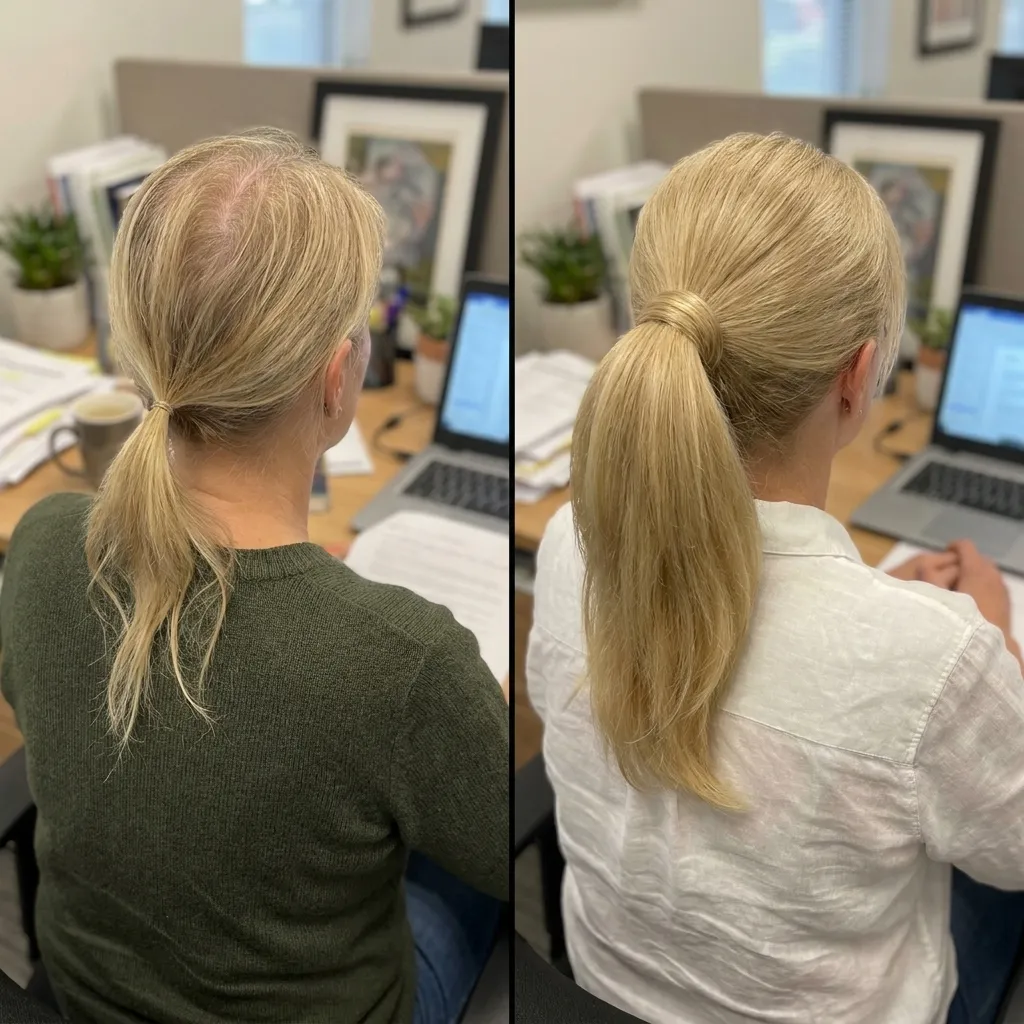
The biggest MISTAKE women over 50 make with thinning hair is trying to force new growth while ignoring what’s making every new strand come back thinner. Let me tell you where to start… STOP trying to regrow your hair. Your biotin isn’t blocking DHT. Volumizing shampoo WON’T stop follicle miniaturization. And even minoxidil doesn’t work the way most women think it does. So if your part keeps widening, your ponytail keeps shrinking, and more pink scalp shows under the bathroom light no matter what you try, there’s something you need to understand first. You may have spent years trying to grow more hair without dealing with what is making each new hair come back thinner. That was me. Biotin. Collagen. A popular premium hair supplement. Rosemary oil. Scalp powders. Serums. Eventually minoxidil. (If it promised thicker hair, I probably tried it.) The products kept changing. The direction didn’t. My hair kept getting thinner. I was 52 when I couldn’t pretend anymore. It started in the shower. I’d wash my hair, feel strands gathering between my fingers, then look down at a drain covered in hair. It scared me so much I started washing less. Then my ponytail changed. It used to feel like a thick rope. One morning I wrapped the elastic around it an extra time and thought: Where did the rest of it go? Then I saw my part. What had always been a thin line was turning into a strip of pink scalp. That’s when the checking started. Bathroom mirrors. Shop windows. Car windows. Photos. Restaurant bathrooms. Anywhere there was a reflection, I looked at my scalp before I looked at my face. I learned to tease the crown, move my part, avoid overhead lights, wear headbands. Then one night I found myself looking at toppers online. That scared me more than anything. I wasn’t trying to look 25 again. Gray hair was fine. Wrinkles were fine. I just didn’t want to spend the rest of my life arranging my appearance around hiding my scalp. I didn’t need longer hair. I needed fuller hair. So I went back to my doctor. He ran bloodwork. Iron. Thyroid. Vitamins. Everything came back normal. “Then why can I suddenly see my scalp?” I asked. “You’re going through menopause. Hair gets thinner as we age.” He recommended biotin and said I could try minoxidil. (Yes. Biotin. Again.) According to my bloodwork, everything was fine. My shower drain disagreed. Still, I followed the advice. Biotin every morning. A popular premium hair supplement. Collagen. Hair vitamins. Scalp powders. Oils. Serums. Minoxidil. Before long, my bathroom cabinet looked like a hair-loss supermarket shelf. Half-used bottles. Supplements I no longer believed in. Oils that made my thin hair look even thinner. And the worst part wasn’t the money. It was how much of my life hair loss started controlling. I noticed restaurant lighting before the menu. I avoided hairstyles that exposed my crown. Before a photo, I fixed my part. Afterward, I zoomed straight into my scalp. Eventually I saw another dermatologist. I brought a list of everything I’d tried and asked one question: “If my bloodwork is normal, what is actually happening to my follicles?” She looked at my scalp and gave me almost the same answer. Female pattern thinning. Menopause. Age. Continue minoxidil if I wanted. (Basically: get used to it.) I went home FURIOUS. I had followed the instructions, spent the money, waited the months, and nobody had explained why my hair kept disappearing. A few days later, my sister asked: “Have you ever heard Dr. Yolanda Holmes explain menopause hair loss?” She sent me a clip. There was one part I replayed three times. She explained that menopause doesn’t simply make a follicle “old.” As estrogen drops, some women’s follicles become more vulnerable to another hormone: DHT. Dihydrotestosterone. Three letters nobody had connected to what I was watching in the mirror. So I started reading. And suddenly the pattern made sense. In follicles sensitive to DHT, the follicle can gradually miniaturize. The hairs it produces become finer, shorter, less substantial. That’s why it doesn’t always begin with a bald spot. Your part widens. Your crown becomes easier to see through. Your ponytail loses weight. “Getting older” told me when it was happening. DHT finally helped explain what was happening. And once I understood that, I had to look at everything I’d already tried differently. The biggest question was minoxidil. If it was supposed to be one of the strongest options available, why could a woman use it for months and still have no idea whether it was going to work for her? That’s when I found out topical minoxidil has to be activated inside the follicle by an enzyme called SULT1A1. (I’d used minoxidil for months and had never even heard of it.) And that enzyme activity varies from woman to woman. Research suggests only around 40–60% of people respond well to topical minoxidil. Meaning you can spend months putting it on your scalp without knowing beforehand whether your follicles are good at activating it. And even if minoxidil does work for you, it still works through a different pathway than directly addressing DHT-related miniaturization. That changed the question for me. I stopped asking: “What else can make my hair grow?” And started asking: “What can I put directly on my scalp to support the follicle without depending on that same activation step?” So I started looking at natural DHT-focused products. And that created another problem. There are hundreds. DHT supplements. Rosemary serums. Caffeine tonics. Rice-water sprays. Random oils. I tried a few. One was so greasy my hair looked thinner after I applied it. Another smelled so strong I stopped using it. Another had one trendy botanical buried halfway down the label. After everything I’d already wasted money on, I wasn’t going to keep guessing. So I went back to the person who had started this whole rabbit hole for me. Dr. Yolanda Holmes. I contacted her office because I wanted one question answered: “If DHT is affecting the follicle, what should I actually be looking for in something I put on my scalp?” The answer was simpler than I expected. Don’t just look for one trendy ingredient. Look at whether the formula is designed for the scalp. Look at whether the ingredients make sense for the follicle. And look at whether you can actually use it every day without making your hair greasy or turning it into another complicated routine. That gave me a completely different way to judge products. And while comparing formulas against that list, I found TryBello Hair Growth Shampoo. For the first time, it didn’t feel like another random bottle I’d discovered at one in the morning. The logic actually matched what I had spent weeks trying to understand. TryBello Hair Growth Shampoo is a daily scalp-focused shampoo that you work directly into your scalp during your shower. And instead of targeting one thing, it was designed to work on the follicle itself. The logic was simple: Put the formula where the follicles are. So I ordered it. I worked it into my part. Massaged it around my crown. Left it on for 60–90 seconds, then rinsed. Done. No handful of pills. No oily scalp. No extra treatment to remember. Then I waited. At first, I wanted dramatic regrowth. But I realized the first thing I really wanted was simpler. I wanted the loss to stop moving in the wrong direction. Less hair in the drain. Less on the brush. No new widening every time I checked my part. Then I started noticing smaller things. Fine hairs near the hairline. The crown looking less transparent under the same bathroom light. My ponytail feeling more substantial. I took photos because I didn’t trust my own eyes. Same bathroom. Same part. Same lighting. Then my hairdresser noticed. She was blow-drying my crown when she suddenly shut off the dryer, ran her fingers through the top of my hair, and looked at me in the mirror. “Okay… what are you doing differently?” I laughed because I thought something was wrong. Then she ran her fingers through it again. “There’s more going on up here.” I almost cried. Not because somebody complimented my hair. Because somebody else had noticed what I was afraid I had imagined. The changes were gradual. But gradual was fine. Gradual was how I had lost the density in the first place. I started wearing my hair down again. I stopped automatically moving away from overhead lighting. Then one morning I realized I had gone hours without thinking about my hair. That sounds small until you’ve spent years checking your scalp every time you pass a mirror. A few months later, I went back to the dermatologist. She looked at my scalp, looked at the older photos in my chart, then asked: “What are you using right now?” For years I had been asking everyone else why my hair was disappearing. Now someone was asking what had changed. And that’s the part I wish somebody had explained to me from the beginning. If you’ve tried biotin, a popular premium hair supplement, collagen, minoxidil, rosemary oil, scalp powders, and serums, and your hair is still thinning, that does not automatically mean your hair is hopeless. It may mean you’ve been using tools built for a different job. So before you buy another hair-growth product, ask: What exactly is this targeting? If your part keeps widening… If your crown is showing through… If your ponytail doesn’t feel like yours anymore… And you’ve already tried everything without understanding why the thinning keeps progressing… TryBello Hair Growth Shampoo is worth looking at because the approach starts directly at the scalp. TryBello also backs it with a 120-Day Empty Bottle Guarantee, so you have time to use it consistently and see what happens without carrying the entire financial risk yourself. You don’t need another vague promise about “beautiful hair.” You need to understand what you’re targeting. Click here to try TryBello Hair Growth Shampoo and finally address the real cause of your hair loss: https://start.trybello.com/shampoo-adv-a476 P.S. – Every day you continue using regular products, you're missing opportunities to fight DHT right at the source. Your hair follicles are under attack 24/7. Why not use the time you're already spending treating your hair to actively fight back? The sooner you address the root cause, the more hair you can save and restore.
More from Trybello

Doc said “it’s just menopause.” She was WRONG.
Trybello
Doc said “it’s just menopause.” She was WRONG.
Trybello

Doc said “it’s just menopause.” She was WRONG.
Trybello
Doc said “it’s just menopause.” She was WRONG.
Trybello
Doc said “it’s just menopause.” She was WRONG.
Trybello
Doc said “it’s just menopause.” She was WRONG.
Trybello
Doc said “it’s just menopause.” She was WRONG.
Trybello
Doc said “it’s just menopause.” She was WRONG.
Trybello
Doc said “it’s just menopause.” She was WRONG.
Trybello
Doc said “it’s just menopause.” She was WRONG.
Trybello
Doc said “it’s just menopause.” She was WRONG.
Trybello
Doc said “it’s just menopause.” She was WRONG.
Trybello

 Add to Chrome