
Stop Shrinking Yourself
Ad Copy
I said sorry to my husband twelve times in one day. I counted. The last one came out of my mouth while I was handing him the plate of dinner I had cooked, in our own kitchen, at our own table. "Sorry, the chicken's a little dry." He hadn't even tasted it yet. I stood there with the oven mitt still on my hand. Something in me went quiet in a bad way. I'm Rachel. I'm 36. Married to Mark for eleven years. Two kids, Nora is seven and Eli is four. I work three days a week at a dental office. On paper, we're fine. Better than fine. Everyone thinks Mark won the lottery. "She's the sweet one," people say at church. Easygoing. Low maintenance. His mom said it best last Thanksgiving. "You're so easy to please, Rachel. You never make a fuss." She meant it as a compliment. It sat in my chest for a week. Because here's what nobody saw. I softened every boundary with guilt. I asked permission for things that were already mine. I dressed every need up as a favor. "Do you mind if, maybe, only if it's not a big deal..." That was how I started every ask. I thought I was keeping the peace. But being the nice wife just meant I disappeared a little more every day. I tried to fix it. I really did. I bought a marriage book about communication. I highlighted half of it. The highlights changed nothing. I listened to a podcast about speaking up. Two episodes in, I felt worse, not better. My friend Dana gave me the line everyone gives. "Happy wife, happy life. Just tell him what you need. He's not a mind reader." So I tried. I wrote three needs on a sticky note. Three. I practiced in the car. That night I read them to Mark. I apologized twice before I finished the first one. Then I apologized for the whole conversation. "Sorry, I know this is a lot." It was three sentences. It was not a lot. Kind people. Kind advice. None of it touched the real thing. Because the real thing was ugly, and I couldn't say it out loud. I resented my husband. A good man. I resented how easily he took up space. He asks for what he wants like it costs nothing. "I'm going to the gym at six." Not a question. Not a sorry. Just a sentence. Some days I even resented my kids. Their needs were so loud. Mine had no sound at all. What kind of wife resents the man she prayed for? What kind of mother is jealous of a four-year-old? I didn't have an answer. So I smiled more and shrank more. Then came a Tuesday morning in March. 7:15. I was making lunches. I dropped a juice box. It hit the floor and I said "sorry." To the floor. To nobody. Nora looked up from her cereal. "Mommy, why do you say sorry so much?" I said, "I don't know, baby." Then I went to the bathroom, ran the fan, and cried for four minutes. I timed it because I had to leave by 7:30. When I came out, I said sorry for taking so long. My seven-year-old had seen it before I did. I was apologizing for existing. That night I couldn't sleep. Around 11:20 I was scrolling in bed, the way you do when your head is too loud. A woman came across my feed talking about an app called Bible Chat. She said she found her "biblical archetype." Fifteen minutes a day. I almost kept scrolling. Honestly, I rolled my eyes. A quiz that tells me which Bible woman I am? It sounded like a magazine thing. Which princess are you, but with verses. And there was another feeling under that one. Embarrassment. Praying about my personality felt small. God has real problems to handle. But it said fifteen minutes. I had fifteen minutes. I had years of fifteen minutes that I'd been handing to everyone but me. So I downloaded it. Not because I believed in it. Because I was tired of the sound of my own voice saying sorry. I took the quiz sitting on the bathroom floor at 11:40 with the door locked. Old habit. I hid everything, even hope. The result came up: Esther. I laughed out loud. Esther was a queen. I was a woman who apologized to a juice box. But I read the first day's reading anyway. It wasn't what I expected. Esther was scared. She stayed quiet for a long time. She hid who she was to stay safe. And then, when it mattered, she got ready. And she walked into a room she was not invited into. I sat on the tile and read that twice. Then I typed a question into the chat, feeling silly. "How do I stop apologizing for having needs?" It didn't lecture me. It pointed me to Esther chapter 4 and said something I still think about. "Esther didn't rush into the throne room. She prepared. Then she spoke, and she did not apologize for coming." Then it gave me one small thing to try. Say one need out loud tomorrow. No sorry attached. Just the need. One sentence. That was the homework. It took me two more days to do it. On day three, I stood in the kitchen and said it. "I need Saturday morning to myself." Full stop. No sorry. My hands were shaking a little. Mark looked up from his phone. "Okay. I've got the kids." That was it. That was the whole thing. Eleven years of guilt over something that cost him one sentence. I went to the pantry and cried for a different reason this time. The fifteen minutes became my anchor. Coffee brewing, phone on the counter, the day's reading, one honest question. Some days it was about Esther. How she waited. How she planned the dinner before she made the ask. How courage and patience lived in the same woman. Some days my questions were smaller. "I feel guilty resting. What does God actually say about that?" It always answered with Scripture. And not once, not one single time, did it tell me to shrink. I had spent my whole life thinking a godly wife was a quiet wife. Turns out I had never actually read the women in that book. They spoke. They asked. They showed up in rooms. The changes were small. I want to be honest about that. No lightning. I stopped saying sorry when someone bumped into me at the store. Me. The one who got bumped. I sent a text that said "no, that doesn't work for us" without three exclamation points and an excuse. I asked for a schedule change at work without a paragraph about how sorry I was to ask. Other people noticed before I did. My sister, on the phone, about a month in: "You didn't apologize once this whole call. Who are you?" Mark, folding laundry one night: "You seem steadier lately. I like it." And then Nora. She dropped a cup, started to say something, and stopped. "I didn't say sorry to the cup, Mommy." She was watching. She was always watching. That one put a lump in my throat. Here's the part I didn't expect. I thought speaking up would cost me my marriage's peace. That was the deal I'd made in my head. Stay small, stay loved. The opposite happened. Mark asks my opinion now. Real questions, and he waits for real answers. We talk at night like we did at 25. Turns out he never wanted a wife who agreed with everything. He wanted me. And I had been hiding her to protect him from her. Two Saturdays ago I was on the porch at 8 in the morning. Coffee. Quiet. My morning. Mark came out, put a blanket over my legs, kissed the top of my head, and went back inside to the kids. Nobody was mad. Nothing broke. The peace didn't leave. That was the lie all along. That peace needed me small to survive. If you soften every boundary with guilt, I know exactly how that tastes. If you dress your needs up as favors so nobody gets upset, I know how tired you are. If being the nice one is making you disappear one day at a time, I need you to hear me. You are not keeping the peace. You are paying for it. Alone. I wrote this for the woman who apologizes to juice boxes. I was her in March. The app is Bible Chat. You take a short quiz and find your biblical archetype, mine was Esther. Then it's about fifteen minutes a day, readings built around her story, and a chat where you can ask anything without feeling dumb. It's free to start. Fifteen minutes. That's less time than I used to spend rewriting one text so it wouldn't sound demanding. What changed for me is simple. I stopped shrinking. And my marriage got closer, not louder. Yesterday I counted my sorries again. Two. I meant both of them.
More from Bible Chat
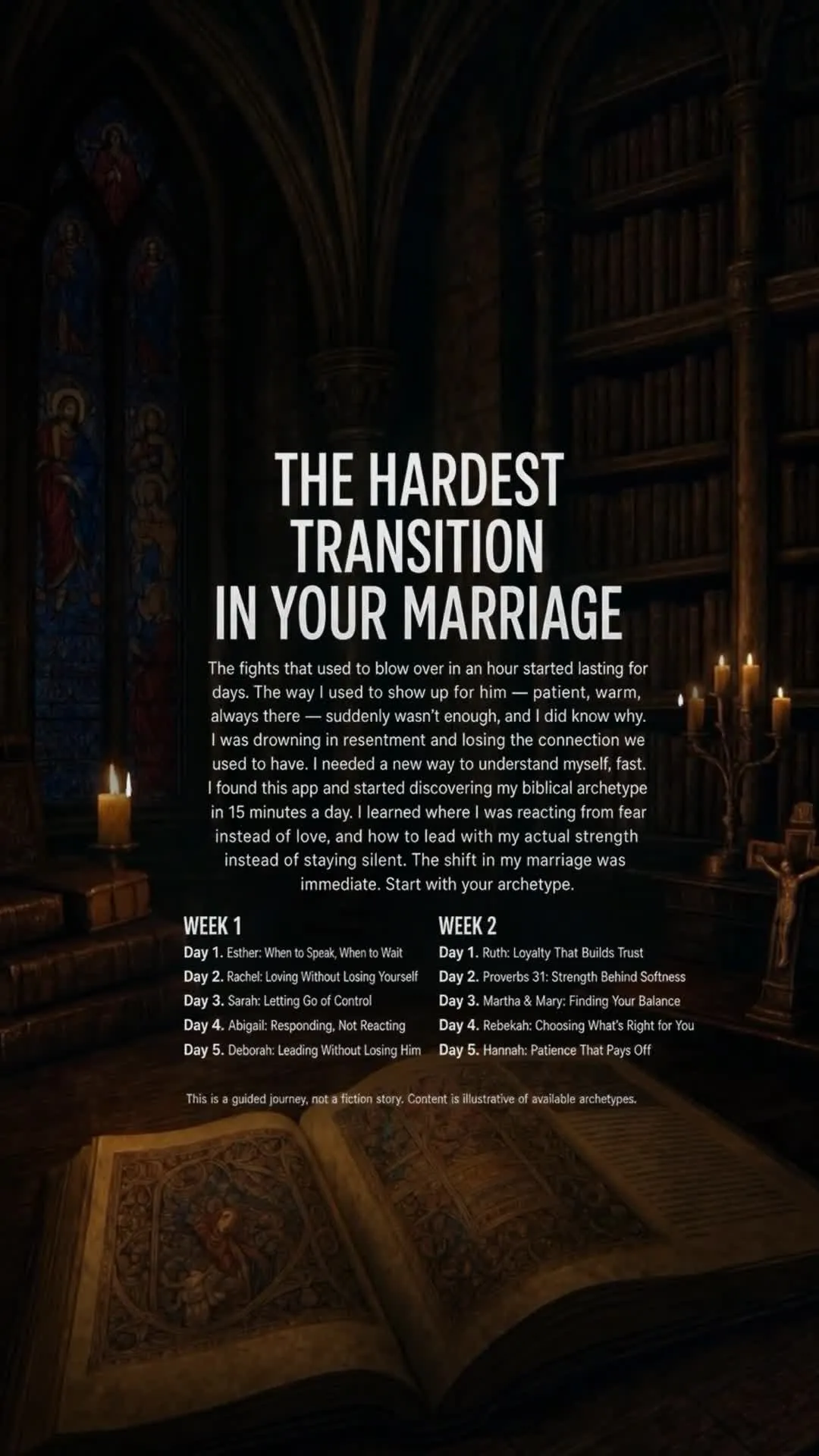
Find Your Archetype
Bible Chat

Rebuild Your Purpose
Bible Chat

Which Woman Are You?
Bible Chat

Find Your Archetype
Bible Chat

Find Your Archetype
Bible Chat

Rebuild Who You Are
Bible Chat
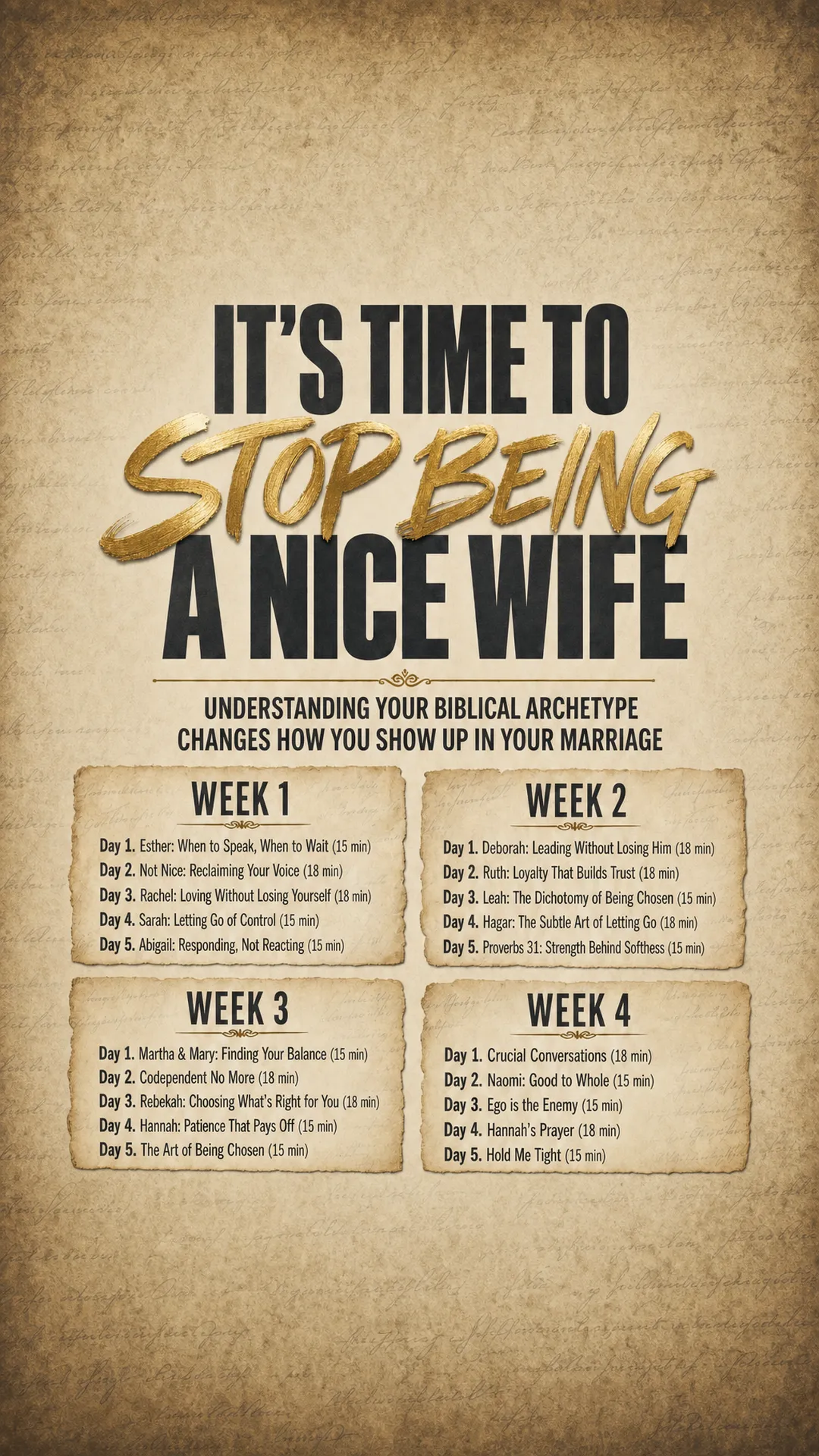
Stop Drifting Apart
Bible Chat

Your room awaits
Bible Chat

Find Your Archetype
Bible Chat

Stop Drifting From God
Bible Chat

Find Your Archetype
Bible Chat
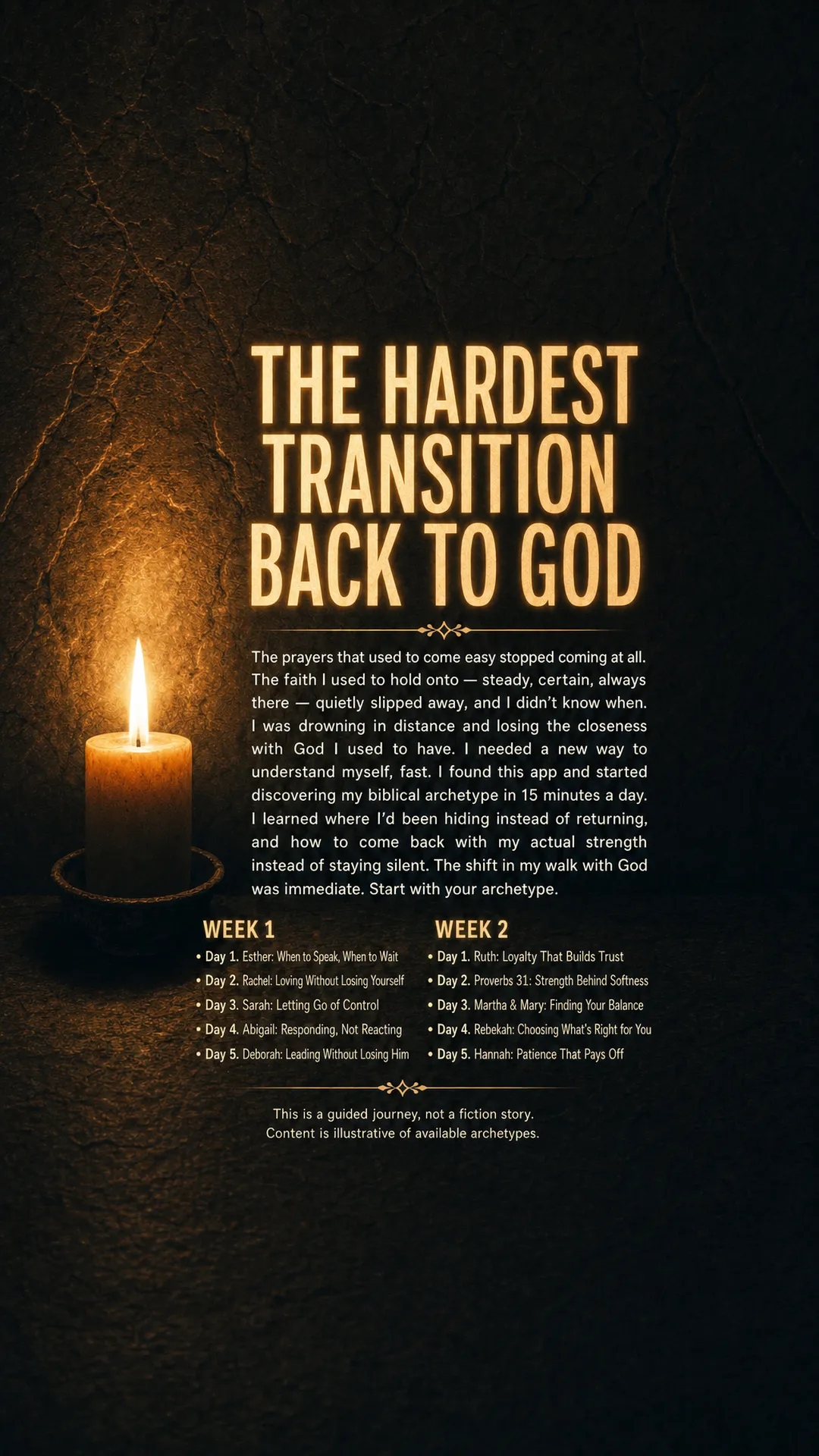
Stop Drifting From God
Bible Chat

 Add to Chrome