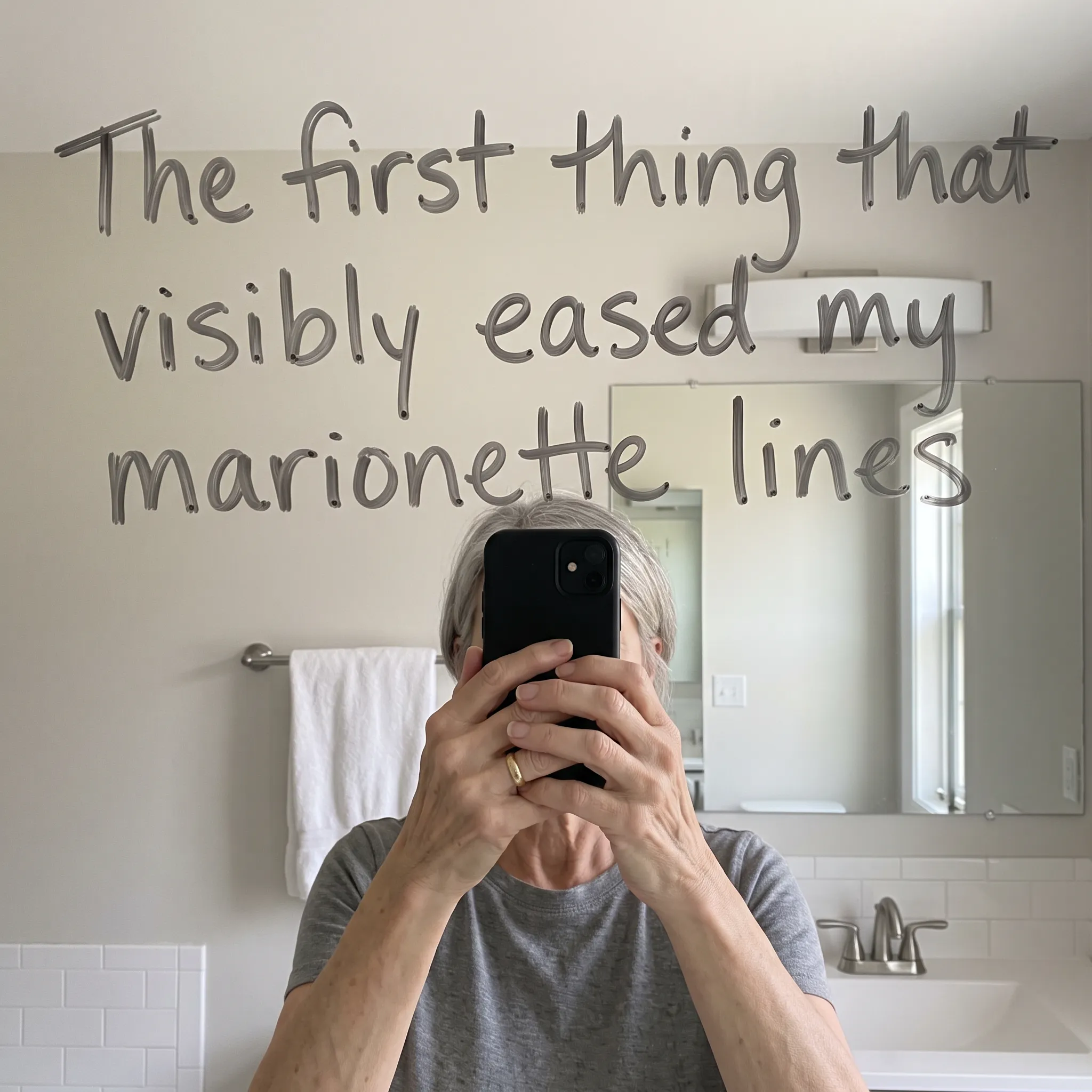
How I Visibly Eased My Marionette Lines
Ad Copy
There were sixty-one jars of face cream in that bathroom, and I know it was sixty-one because counting other people's things is what I am actually paid to do. I had been in the house about forty minutes when I opened the cabinet over the sink. And then I stood there long enough that the daughter came down the hall to find out what was wrong with me. I need to tell you what she said, because it is the reason I am typing any of this. But I have to back up first, or none of it lands the way it landed on me. I should say that I have started and deleted this three times. It is somebody else's mother and it is somebody else's bathroom and I am aware that it is not mine to hand around. I have changed the details that would identify anybody. What I have not changed is the number, because the number is the only part that matters and rounding it down would be doing exactly what everybody did to her. I am sixty-three. I work estate sales, which is a phrase that makes people picture something much grander than it is. What it actually means is that after somebody dies, and after the family has taken the photographs and the wedding rings and whatever else they cannot bear to have priced, I come in with two folding tables and a roll of stickers and I go through the rest of it. Every drawer. Every closet. The garage, which is always the worst. I have been doing it eleven years and I am good at it, and the part I am good at is not the pricing. It is that I go slowly and I do not throw anything away before somebody has looked at it. Eleven years of this has taught me one thing I did not expect to learn, which is that you cannot lie to a house. People will tell you anything about themselves. A house just sits there with everything in it. I have opened freezers with nine years of soup in them, labeled. I have opened a nightstand and found forty-one pairs of reading glasses in it, all cheap, all identical, because a man kept losing them and kept buying more and never once thought to put a pair in every room. You find out what somebody was worried about, and you find out how long they were worried about it, and you find out whether anybody ever helped them with it. You are not supposed to have opinions about that. I have opinions about it constantly and I keep them to myself, and then I go home. This one was a white house on a street of white houses, three bedrooms, one owner since 1974. Her name was Eileen. She was eighty-one and she had died in March, at home, which the daughter told me twice in the first ten minutes the way people do when the fact is still doing something to them. It was a Tuesday. It is always a Tuesday, because families want the sale on a Saturday and I need four days. The daughter met me at the door with a coffee she had bought me on the way, which almost nobody does, and then she stood in the front hall not going anywhere for about a minute and a half, and I have learned to just let people have that minute. The house was tidy in the particular way that tells you a woman lived alone in it for a long time and had a system. Dish towel folded in thirds over the oven handle. Every lid on every pot in a rack by size. In the hall closet, a shoebox of Christmas cards going back to the eighties, rubber-banded by year, and I want you to hold onto the fact that this was a woman who kept things in order, because it matters in about four paragraphs. I did the living room first, which is always the fastest room in any house because it is the room that was arranged for other people. Two chairs facing a television. A side table with a coaster on it and a ring under the coaster. A cabinet of glasses that had been used maybe four times, at Christmas, in a house where Christmas had clearly stopped happening some years before she did. Then the bedroom, which took most of the morning, because bedrooms always do. Her closet was organized by sleeve length. There was a wooden hanger every fourth garment, which is a system I have only seen twice, and both times it belonged to a woman who had worked in a store. On the top shelf, in a hat box, were her husband's ties, which meant he had gone first and she had kept them, and the box had a layer of dust on the lid but the ties inside were rolled. Then I went into the bathroom, which is normally a ten-minute job. Towels, a hair dryer, a scale you throw out. I opened the cabinet over the sink and there was no cabinet left. It was jars. Three shelves of them, packed front to back and stacked two deep on the bottom shelf, so that when I pulled the first row forward there was a whole second row behind it that had never been touched. Squat glass ones with heavy lids that weigh more than what is inside them. Tall pump bottles. Little pots the size of a shot glass with gold on the cap. A couple of the wide flat ones that come in a box with a folded paper inside explaining the ritual. Some were scraped down to nothing, with that hard ring of dried cream around the rim where she had gone around the edge with a fingernail to get the last of it. Some were half. And some, and this is the part that stopped me and still stops me, some were sealed. Still in the plastic film. Never opened. Bought and put away and superseded by the next one before she ever got to them. There is a smell to a cabinet like that, too, which I was not ready for. Not perfume exactly. Something heavier and older, the way a closed-up room smells, except sweet. I counted them, because I did not know what else to do with my hands. I did it twice. Sixty-one. Then I went and got the daughter. She came in and looked at the open cabinet and did not look surprised at all, which surprised me. She just said, sort of tiredly, "Oh. Yeah. She bought a new one every month. She never missed." I asked her how long. She thought about it, actually thought about it, standing in the doorway with her arms folded, and then she said: since I was in my twenties. She is fifty-six now. Then she said the other thing, and this is the one that has stayed with me. She said her mother used to ask her, every time she visited, whether she could tell. Whether it was working. And she said she always told her yes. She said it the way you say something you have not said out loud before and are not sure you are allowed to. Then she said, "What was I going to say? She was eighty. She was so hopeful about it every single time." I did not have anything to give her back for that. I still do not. I told her I would be careful with everything and she went back down the hall. So call it thirty years. Thirty years, a new jar every month, and what was in that cabinet was only what fit. Only the last five years or so. Everything before that had been used up and thrown out and replaced on schedule by a woman who folded her dish towels in thirds and rubber-banded her Christmas cards by year, and who therefore was not confused, and was not careless, and did not forget what she had already tried. She knew exactly what she was doing. She did it three hundred and sixty times. I stood in a dead woman's bathroom and started doing the arithmetic in my head, and I got about halfway and stopped, and I have gone back to it a few times since and I keep coming out higher, and I am not going to write the number down here because whatever I put would be wrong and somebody would want to argue about the wrong thing. Do it yourself, roughly, using whatever you last paid. Twelve a year. Thirty years. That is the floor, and the floor is already a used car. And the money is not even the part that got me. The money is the part you can recover from. What got me is that a woman spent three decades of small monthly hope on a category of thing that was never once going to do the job, and nobody in that entire thirty years told her so, and she died still buying it, and the last two she bought are sitting in that cabinet in their plastic film because she ran out of time before she ran out of faith. The part that got me hardest was the last three jars in the front row. I own two of them. The third one is in my medicine cabinet at home right now, and I bought it in April, and I have used it every night since, and I have been telling myself it might be doing something. That is when it stopped being a job. I was not looking into Eileen's cabinet anymore. I was looking into mine, twenty years out, if I keep going exactly the way I am going, which up until that morning I had every intention of doing. Except mine will be somebody else's Tuesday, and somebody else's coffee handed over at the door, and somebody else standing in my bathroom with a roll of stickers counting to sixty-one and wondering what on earth I thought I was doing. I want to be very clear that I did not have a revelation in that bathroom. I had the opposite. I had the specific, unpleasant feeling of recognizing yourself in a stranger and not being able to argue your way out of it, which is not a nice feeling and did not resolve for about a week. I want to be accurate about my own face rather than kind about it, because I have watched too many women be gentle with themselves in a way that just costs them another decade. I have marionette lines. They are the thing I see first now, every time, before I see anything else, and they drag each mouth corner downward, so my resting face reads as disappointed in somebody. People ask what has upset me when nothing has upset me. A man at a gas station told me to cheer up, which is its own conversation and not this one. My nasolabial folds used to arrive when I smiled and leave when I stopped. They do not leave anymore. They are just part of the face now, present at rest, and there was no day when that happened, which is somehow worse than if there had been. I have mouth wrinkles at rest, the fine vertical ones above the lip, and my lipstick has started finding them and traveling up into them within about an hour. Nobody warns you about that one. I find it more insulting than it probably deserves. I have smoker's lines. Nobody in this house has ever smoked anything. And underneath all of it, I have sagging jowls, and I have the neck, and those two are the ones that actually changed the shape of my face rather than the texture of it. That is the distinction nobody makes and it is the one that matters. A line is on your face. A jowl is your face, in a different place than it used to be. There is more of me along the jaw than there used to be and it is lower down. I noticed it first in the way a scarf sat, of all things, because it stopped sitting on a jawline and started sitting on something softer. Then I noticed I had started angling my chin in photographs without ever having decided to do that. Now I notice it when I turn my head at the wheel of the car, because something moves that did not used to move, and I feel it before I see it. So I am not standing outside this. I am sixty-one jars into it myself, just spread over fewer years, and the only reason my cabinet is not Eileen's cabinet is that I am twenty years behind her, not that I am any smarter about it. I went home that night and I got everything out of my own cabinet and put it on the bed, which I recommend to absolutely nobody. There was the L'Oréal one, the big pot, which is the one I always come back to when I am being sensible about money, and which I have repurchased so many times that the checkout at the drugstore has stopped being an event. There was a La Mer that my sister gave me for my sixtieth. I rationed it like it was medicine. A quarter teaspoon at a time, warmed between my fingers first because there is a whole method, for eleven months, and I made it last because I knew what it cost her. I would still describe it to you as lovely. It felt like nothing else on my shelf felt. That is a true sentence and it is also completely beside the point, and I will come back to why. There was a SkinCeuticals serum with a glass dropper that I bought at ten o'clock at night after reading about it on my phone in bed, which is the correct time and place to buy something you are going to regret. There was The Ordinary retinol, the cheap one everybody swears by. I used it religiously. Every other night, then every night, building up the way you are supposed to. It made me peel for two weeks. I decided that meant something was happening. Nothing was happening. And then the rest of the row. A hyaluronic acid serum. A vitamin C serum that had gone brown in the bottle, which I understand means it stopped working at some point I could not identify. A night cream. An eye cream. And a neck cream, which is its own particular insult when you sit and think about it for a second, because somebody looked at what was happening to women's necks and decided the correct response was a second jar at a second price. I lined all of it up on the bedspread in a row, like I would have priced it, and I looked at it, and the question I finally asked, at sixty-three years old, having spent what I have spent, was: where does any of this actually go? Not does it work. I already knew the answer to does it work. I was standing there holding the answer to does it work. Where does it go. It took me one evening to find out. One evening, at my own kitchen table, with the jars still on the bed in the other room because I had not wanted to put them back. The anger showed up that same evening and it has not left, and the anger is the useful part, so I am going to hand it to you in the order it arrived. Start with the two things every woman my age has already been told to do, because they are what you are thinking about while you read the rest of this, and I would rather clear them out of the way than talk over them. Botox works. There is no argument to have there and I would not pretend there was. A shot of it relaxes the muscle underneath a specific crease so that muscle stops folding the skin, and if what bothers you is caused by a movement you make forty thousand times a year, it does exactly that job, and does it well. But my jowls did not get here from a movement, and neither did my neck. No muscle exists that anybody can relax to put the bottom half of my face back up where it used to sit, because it did not get here by being pulled down. It got here by having less underneath it holding it up. So the honest version is that Botox does the one thing Botox does, and that is the entire problem, because the one thing it does was never the thing that had gone wrong with me. Filler works too. Same deal, no argument. What filler costs is what filler costs, and then it costs it again, on a schedule, forever, because it migrates and has to be redone. You are not buying a result. You are buying a standing appointment with a needle in it and an office that calls you when you are due. A woman I set up tables with had it done twice and stopped, not because it failed but because she did the multiplication out to age seventy-five and did not like the number. Now the jars. Sixty-one of them in a cabinet and ten of them on my bed. Anti-aging cream, then retinol, then whatever the next one is going to be called by the time you read this. They get stopped by your skin barrier before they ever penetrate deep enough to reach where the collagen is produced. That is not a technicality and I want to slow down on it, because it is the one thing I wish a single person had bothered to explain to me twelve years ago. Collagen is not made on the surface of your face. It is made underneath, a long way below anything you can put your fingers on, and it is the structure that holds everything above it where it is. The barrier is the layer your skin built for one specific purpose, to keep whatever you put on top of it from ever reaching down there. It is not broken. It is working exactly as it was designed to, and it cannot tell the difference between a four hundred dollar jar and a nine dollar one, because it never reads the label. So a cream goes on the top. It does the top. It can genuinely make the top feel better, and that is real, and that is what I was buying for years without understanding that it was all I was buying. Meanwhile, wherever the actual loss is happening underneath, not one thing I paid for ever reaches it. Not a molecule of it. That is why nothing moved for Eileen in thirty years. That is why nothing moved for me. It is not that either of us picked badly. It is that none of it can reach the place the damage is actually done, so none of it works. And that is also the answer to the La Mer, which I told you I would come back to. It felt like nothing else on my shelf. It was, by every measure I could apply to it standing in my own bathroom, the best thing I owned. It stopped in exactly the same place as the nine dollar one. Which means what I needed was never going to be a better jar. It was a way in, underneath the barrier. That is what Micro Infusion is. It is a treatment, and the whole point of it is delivery. It uses super-fine, 24k gold-plated, 0.5mm microneedles, sterile and virtually painless, and it delivers a powerful peptide serum packed with bioactive collagen peptides and hyaluronic acid deep into the skin and actually reach where the collagen is lost. That process boosts your collagen production and transforms the look of your face from the inside out. Visibly diminishing the wrinkles and lines around your mouth, your nasolabial folds and your marionette lines. While visibly tightening, firming and lifting the sagging around your jowls and your neck. None of that comes from a night cream, and it does not come from a retinol either, or from the neck cream they invented so you would buy a second jar. Nothing in any of them can get in deep enough to change what I could actually point to, and that is simply the limit of what they were ever built to do. In a dermatologist's office, that treatment runs five to seven hundred dollars a session, more or less. That is a weekday off, and an appointment you booked six weeks ago, and a drive, and a waiting room, and it is not one session, it is a course of them. Which is a real answer for a woman who has that, and was not a real answer for me, and was not going to be a real answer for a woman who was buying a jar a month because a jar a month was what she could manage. Then I found out that a US skincare company has made the same technology available at home at just a fraction of the cost with their Micro Infusion System. Five minutes, twice a month, at my own bathroom sink with the door shut and nobody's calendar involved but mine. So here is what it has not done, because I have now personally counted sixty-one jars of somebody else's hope and stacked them into two banker's boxes, and I have no intention of adding one thing to that pile. My marionette lines have not gone anywhere. Neither have my nasolabial folds. Both of them turn up in every photograph from this year, there was no magic involved, and nothing was erased. I would not believe anybody who told you different. A woman of sixty-three with no creases in her face is a woman who has had something done that this is not. What is different is only what shows up when I look, on my own face, in my own bathroom, and I am not pretending that is anything more than one woman's account of one face. Around my mouth, the wrinkles read visibly softer to me. My lipstick no longer travels, all day, which is a small stupid thing I notice every single morning and would never have guessed would matter to me this much. My marionette lines read less deep to me than they did, enough that my face at rest has stopped announcing an opinion I do not have, and enough that nobody at a gas station has told me to cheer up in a while. Then the lower half of my face, which is the part I actually minded, and the part I assumed nothing short of surgery was ever going to touch. My jowls look visibly tighter to me. The line of my jaw reads visibly firmer. My neck reads visibly lifted. When I turn my head at the wheel now, nothing moves that I can feel, and I had not understood how much I had been bracing for that until it stopped happening. The scarf sits differently. That is the one that got me, honestly. Same scarf. Somebody else spotted it before I did, and that is not at all how I assumed this would go. I had assumed that if anything ever changed I would be the one to spot it, because I am the one standing four inches from it every morning. It was the other way round. You lose the ability to see your own face somewhere in your fifties. You see the thing you are checking for. A woman I have set up tables with for six years asked me flat out what I was doing differently. She did not believe me when I said nothing, and she asked me again two weeks later. My brother, in six decades of knowing me, has never had a single remark to make about how I look. He said I seemed less tired, and then looked faintly embarrassed about it, and changed the subject to his gutters. I should be straight about the limits of that, because I have just spent most of a page telling you about a woman who was told for thirty years that something was working. This is my face. It is one face. I am telling you what I can see on it, and what two people said to me about it, and that is the whole extent of what I know. I finished Eileen's sale on a Saturday. Everything went. It always goes. A woman bought the wooden hangers. A man bought the pot rack. Somebody's teenage kid bought the hat box for four dollars and I took the ties out of it first and put them in the daughter's car without asking her, which is not strictly my job, and which I will keep doing. By two in the afternoon the house was three folding tables and an echo, and the daughter walked through it once at the end the way they all do, and stopped in the bathroom doorway for a second longer than the other rooms. She did not say anything about it. Neither did I. There was nothing either of us could have said in that doorway that would have been worth the air. I did not price the jars. I could not. You cannot put a sticker on that and stand behind a table while somebody picks one up and turns it over and puts it back down. I asked the daughter what she wanted done with them and she said, do whatever, in the voice people use at the end of a week like that. So I put the whole cabinet into two banker's boxes and carried them out and set them on the passenger seat, and then I sat in that driveway for a good ten minutes with the engine off, trying to work out what the respectful thing to do with them was. There is no respectful thing to do with them. They are sixty-one jars. Two of them have never been opened and never will be. I drove them home and they are in my garage and I have not dealt with it. What I kept was the shelf. Not literally, I mean I kept the picture of it. When I had taken every last jar out, the shelves underneath were covered in rings. Perfect clean circles in the dust where each one had stood, dozens of them, overlapping each other where a jar had been moved an inch at some point and put back slightly off. Three shelves of it. You could read it like something at a dig site. You could see exactly how long every single one of them had sat there without ever once being the answer, and you could see the ones that had been shoved to the back and never moved again. I took a picture of it on my phone before I closed the cabinet. I still have it. I look at it more often than I should and I have not been able to make myself delete it. I have shown it to exactly two people. Both of them said the same thing, which was: what am I looking at. And then both of them went quiet for a second once I told them, and then both of them said some version of the same second thing, which was that they have got one going too. One of them is forty-four. She has already got a shelf. Because that is the whole thing, isn't it. She was not foolish. She was not vain. Vain is not even the right word for any of us and I would like it retired. She was a woman who was told, for thirty years, by every single thing she had access to, that the answer to her face was a jar. She believed it. She was thorough about it, the way she was thorough about her dish towels and her Christmas cards. She was completely wrong through no fault of her own. And in thirty years, three hundred and sixty purchases, not one single person ever told her where the stuff in the jar actually stops. I keep thinking about her asking her daughter whether she could tell. Every visit. Getting told yes, every visit, by somebody who loved her and could not think of anything better to say. That is not a story about a face. That is thirty years of a woman being quietly managed on a subject nobody would give her a straight answer about. I would like somebody to have given her the straight answer at sixty. She had twenty-one years left at that point. That is a lot of Tuesdays. If you are in your fifties or sixties yourself, and you have a cabinet like that going, or the start of one, or a drawer, or a shelf in the linen closet you do not mention to anybody, then I am not telling you that you wasted your money because you picked the wrong brand. That is what the next jar is going to tell you. That is the only thing the next jar can tell you, because "you had the wrong one" is the entire business model, and it works forever, and it worked on a very organized woman for thirty consecutive years. What I am telling you is that what is happening to your jowls and your marionette lines and your nasolabial folds is happening underneath, and that almost every single thing that has ever been sold to you for it is designed to be applied on top. That is not a small difference. That is the entire difference. It took me sixty-one jars in somebody else's bathroom to see it, and I would rather you saw it for free. 👉 https://go.dermareviewsonline.com/229b9a2b-b4bc-45a8-a69f-8303f2dd0663
More from Stephanie Edwards

Wrinkles & Sagging Skin? Try This 5-Minute Remedy
Stephanie Edwards

Wrinkles & Sagging Skin? Try This 5-Minute Remedy
Stephanie Edwards

Wrinkles & Sagging Skin? Try This 5-Minute Remedy
Stephanie Edwards

My Daughter Took One Photo Off My Wall
Stephanie Edwards

Here's How I Visibly Softened My Mouth Wrinkles
Stephanie Edwards

Watch Me Visibly Soften My Mouth Wrinkles
Stephanie Edwards

What Actually Works on Mouth Wrinkles?
Stephanie Edwards
There Were Fourteen. Now There Are Thirteen.
Stephanie Edwards

Wrinkles & Sagging Skin? Try This 5-Minute Remedy
Stephanie Edwards

Wrinkles & Sagging Skin? Try This 5-Minute Remedy
Stephanie Edwards

I Paid Full Price — Now It’s On Sale 😭
Stephanie Edwards

What Actually Works on a Sagging Jawline?
Stephanie Edwards

 Add to Chrome