AutisticOrNot Assessments | Adult Autism Assessment
Ad Copy
#AdultAutism #Update Within our very deep programme for undiagnosed adults who suspect autism, we are beginning to see a striking pattern. Some questions receive very high agreement scores from people who also score as likely autistic across every major area of the programme. These are not isolated answers. They sit within a wider profile that includes social processing, sensory experience, masking, recovery, communication, emotional load, routine, focus, adaptation and lifelong patterns of difference. Because of that, these responses are especially interesting because they are not questions asked in standard clinical settings. They should be. The answers that stand out are not only the familiar ones often associated with autism. They are about how people manage modern life and even technology. They include high agreement with statements about being disrupted by even small changes to digital schedules, relying heavily on digital calendars, reminders and apps to manage tasks, struggling when priorities change suddenly, needing more recovery time after mentally demanding work, wanting clear step by step instructions or clear expectations even during remote work, losing track of time when absorbed in work, spending a long time planning before doing, and avoiding complex tasks unless the approach is clear or documented. These are important because they point to areas that are not always studied deeply in standard clinical situations (many "tests" are decades old), but arguably should be. Many traditional assessments focus on developmental history, social communication, repetitive behaviours and sensory issues in childhood. Those areas matter, of course, but they do not always capture the full experience of being autistic in the world we live in right now. Today, people are expected to cope with constant notifications, shifting work priorities, vague instructions, flexible schedules, digital administration, fast decisions and mentally demanding tasks that often have no clear endpoint or milestone. For many autistic adults, these are not small practical details. They are central to daily functioning. And many of these people are not able to access diagnosis or even know why they "feel" this way. Barriers. This is why our programme looks at these patterns in context. We are not treating one answer as evidence of autism. We don't even diagnose. We are looking at how these answers behave across the full programme, how strongly they correlate with people who score as likely autistic in multiple areas, and how they compare with participants who also report a formal autism diagnosis in our programme development. That cross checking matters. It helps us understand which experiences may be especially meaningful, which may be common across other groups, and which may reveal important modern expressions of autistic life that older frameworks do not always describe well or even touch on. The workplace is an obvious area where this matters. If people who are likely autistic are repeatedly telling us that sudden changes by email, unclear expectations of video calls, excessive cognitive load and disrupted planning affect them strongly, then workplaces need to evolve. As does autism testing. This does not mean lowering ambition or assuming incapability. It means designing better systems. Clearer instructions at work, stable priorities, written expectations, proper notice of change, realistic recovery time and respect for planning are not indulgences. They are practical ways to help people do better work. All people and especially autistic adults or those who suspect they might be. In that sense, these findings are not only about autism. They are about the gap between human nervous systems and the modern environments we have built. Autism research, assessment and workplace design all need to keep pace with that reality. The modern autistic experience is not only found in childhood memories or clinical checklists. It is also found in calendars, task systems, meetings, deadlines, interruptions, recovery time and the daily effort of translating a fast-moving world into something manageable. www.AutisticOrNot.com - Award Winning 2Hr Online Adult Autism Assessment, created by a 100% autistic team.
More from Autisticornot
Am I Autistic?
Autisticornot
UK Adults £19, Autism Reflection
Autisticornot
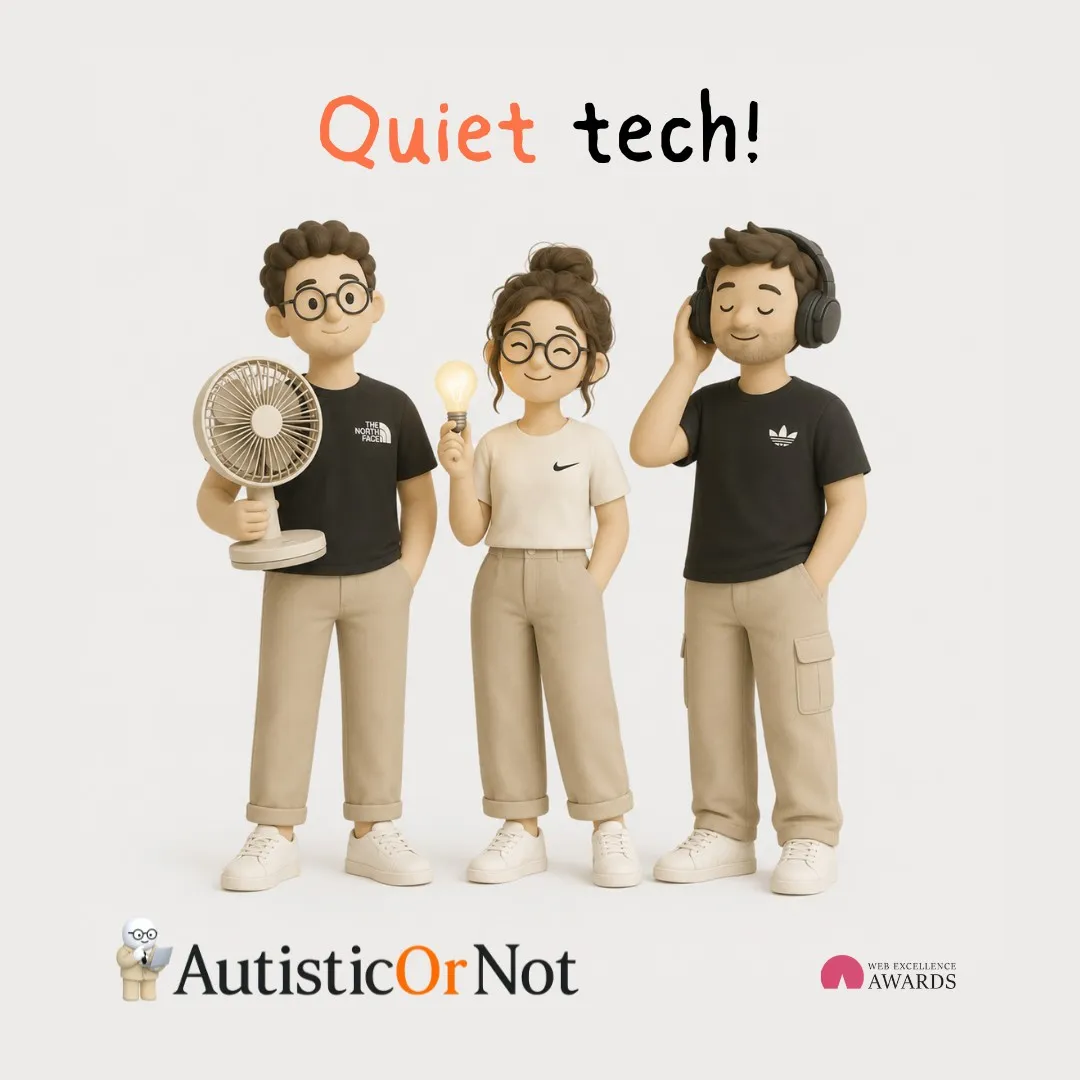
"Quiet Tech" that keeps the world a little more contained : an 8 minute read for adult autistic folk and their pals! We have not done this before. But seeing as we are a fairly geek-heavy autistic team, we thought we would start publicly answering some of the things we get asked. Not just about understanding autism itself, but about modern life as an autistic adult. The practical stuff. The daily stuff. The things that make the world feel a bit more contained. And because it has been oddly warm in the UK, and some of our team are also based in warmer parts of Europe, we thought we would start with fans! We know some of you use them for neutral noise impact in the room but we'll also focus on how well they work at actually being fans! We have included a little more detail than usual, knowing our tribe rather likes that. Also, when you rely on something for more specific reasons than other people might, the details matter. It is not just whether it works. It is whether it is easy to use when you are tired and creating your comfy place. Whether it makes a strange noise. Whether it feels nice to control. Whether it looks good enough to live with. Whether it has a decent warranty if it becomes part of your daily survival kit. Usual AutisticOrNot caveat: this is not medical advice. It is not sponsored. It is also not a universal sensory prescription, because autistic people do not all need the same environment. Some of us need silence. Some of us need a constant background hum. Some cannot tolerate headphones. Some cannot function without them. Some of us have bought so many “quiet” products that we now treat the word quiet on a box as more of a challenge than a promise and retail universe has not yet quite won us over. We also know that not everyone has the money to splash on expensive tech. Nobody should feel bad if some of these things are out of reach. But for modern adult autistic life, some tech and sleep help can make a real difference. Sometimes these are the things we save for more carefully than we would save for a new laptop or even a vehicle, because they affect every day. Every night. Every trip to the store. Every heatwave. Every recovery period. If you can find some of the older versions, you might find yourself thanking the penny-jar. So this might be useful for you. It might also help if you are thinking about a gift for someone you love. Especially someone who does not need more clutter, but might really benefit from something that makes life feel less loud, bright, scratchy or unpredictable. Especially if that person works from home (as many of us do by choice, if we can) and if you want to get them something practical as well as wished-for. The broader point of heat, sound and light within products for the autistic adult is well recognised. Sensory differences are now part of the formal diagnostic picture of autism, including being over- or under-reactive to sensory input, or having unusual interest in sensory aspects of the environment. Research with autistic adults also shows what many of us already know in real life: sensory experiences are not small side notes. They can affect comfort, energy, daily choices, public life and whether the day feels manageable. So, waffle aside, the fan we keep coming back to is the Rowenta Turbo Silence Extreme range. Not because it is just “quiet” in the marketing sense. Because it can move air gently without the motor becoming the main event and it does it whilst looking great and functioning year after year. We've got one in every room now at HQ. A lot of fans are tolerable for five minutes. Then you notice the whine. Or the clicking. Or the vibration through the floor. Or the slightly uneven rhythm your nervous system decides to monitor for the rest of the evening. Yes, that really is something that drains us often. The Rowenta models are not silent, because fans remain fans, but they are much closer to what we mean by actually quiet. It's not an easy thing to achieve through engineering of something that needs to move air at speed! The technical detail that matters here is not just volume, but sound quality. Some Rowenta models list quiet settings around the mid-30 dB range, which is roughly the level of a very quiet room. The Rowenta Nomad is even quieter on paper, listed at around 18 dB on its lowest setting. To put this into perspective, a cheapy fan can often reach 60 dB or more. To be fair, that lowest setting on the Rowanta Nomad is more like a small movement of air than a powerful blast. But sometimes that is exactly what you want. It is not trying to cool a huge room. It is just a soft, barely-there breeze that feels good on tired skin. Decibels do not tell the whole story, though. A stable low sound can be much easier to live with than a tiny high-pitched motor whine or a repeating mechanical tick. Oscillation matters too. Even if the fan itself is quiet, you may still hear it turning from side to side if you select that setting, because the sound changes as the fan moves. If changing sound bothers you, fixed direction may be better and you get easy options here. One oddly important detail: some of the newer Rowenta fans, including the Nomad range, do not beep every time you change a setting. It just changes it without a notification. This sounds tiny, unless you are the person using it at night, already hot, already tired, trying to turn the fan down without being electronically scolded by ear. For some of us, no unnecessary beep is a genuine design feature. They are not the cheapest fans. As a rough guide, expect somewhere around £100 to £170 in the UK depending on which one you get (all the Silence Extreme ones are good, they just have different sizes, remotes and power), and around $150 to $220 in the US, depending on model, season and retailer. But for us, the value is partly that they do not seem to break every summer, which is surprisingly rare in fans. Now the one people often think of when they consider autism tech. Headphones! Headphones are harder, because headphones are very, very personal. Plus they touch the skin directly and need to operate in multiple environments. For some autistic people, they are a no-go. The pressure, heat, ear-cup feeling, in-ear sensation, Bluetooth lag, or active noise cancellation effect can all be too much. For others, headphones are essential. They can make supermarkets, trains, offices, kitchens, waiting rooms and streets more possible. I switch modes. Often wearing mine for days and then when I feel stronger, leaving them at home for the rest of the week. You do you. The feature we like most on headphones is being able to switch between full active noise cancellation and transparency or "aware mode". Full noise cancellation helps when the world is too much. Transparency mode helps when you still need to hear speech, traffic, announcements or someone talking to you. That matters because being completely sealed off is not always comfortable or safe, especially outside. For many of us it's just nice to turn things down, not entirely switch the world off. One of the most famous innovators in "quiet tech" is Bose. Bose QuietComfort headphones (the big, over-ear type) are still difficult to beat, although the naming can be confusing because there are now several versions around. The latest top model is the Bose QuietComfort Ultra Headphones, 2nd Gen. These are the newest premium over-ear Bose option, with Bose’s strongest noise cancellation, plush comfort, Immersive Audio, USB-C audio, improved battery life and newer refinements such as Cinema Mode. They are the expensive ones, usually sitting at the top end of the range. You really, really don't need those unless you're also a big fan of the movies and in the mood for something incredible on that front! The sensible current buy for many people is still the Bose QuietComfort original Headphones, released in 2023. These are not the newest Ultra model, but they still give you strong noise cancellation, Quiet and Aware modes, app customisation, USB-C charging (we like only having one cable for things), a comfortable classic design and up to around 24 hours of battery life. In 2026, these are often the ones to look for if you want proper Bose noise cancellation without paying for the latest premium version. If you are looking second-hand, refurbished or in older stock, the Bose QuietComfort 45, often called the QC45, is still worth knowing about. It came out in 2021 and has been replaced, but it can still be a good buy if it is clean, genuine and meaningfully cheaper than the newer models. Plus you can buy new pads to fit so they feel absolutely fresh. So the short version is this: latest and best, QuietComfort Ultra 2nd Gen. Best sensible current buy, Bose QuietComfort Headphones from 2023. Older bargain to watch for, QC45. What Bose tends to do well is not just blocking noise, but making the reduction feel smooth and usable for longer periods. The controls are also simple, which matters when the whole point is reducing load, not adding another problem to a busy and stressful moment. The physical comfort matters too. Bose QuietComfort ear pads are soft, smooth and cushioned rather than scratchy or stiff. Mine feel "seamless" which is exactly my goal. The replacement ear cushions are described as protein leather, which is synthetic leather, with soft foam underneath. Bose sells replacement cushion kits, which is useful because the ear pads are part of the seal that helps the noise cancellation work properly. For sensory use, the texture and pressure on the ear can be just as important as the noise cancellation itself. As a rough guide, Bose QuietComfort headphones are often around £150 to £350 in the UK, or $200 to $450 in the US, depending on model, age and offers. The newest Ultra models sit at the expensive end. Older QuietComfort models are often the sensible choice. The Sony WH-1000XM5 headphones also deserve a special mention. They are incredible headphones. And because the newer WH-1000XM6 is now out, the XM5s seem to be on sale in a lot of places. Okay, you can tell we're autistic AND geeks now, but bear with us. They are still genuinely excellent, especially if you want strong noise cancellation, good sound, long battery life and a slightly more modern shape than many older over-ear headphones. The case is good too. I love the texture of it. They also come in softer colours, including silver and a sandy pink, depending on retailer and region. Honestly, that just feels better than everything being black. The material texture of the cup on the ear itself is fine in our opinion: smooth, soft and not scratchy. But, as always, try them on if you can. Headphones are one of those things where the technical reviews can be perfect and your ears can still vote no if you're like us. These are probably the headphones we would buy if we did not already own the Bose. For in-ear buds, Xiaomi and Redmi are worth looking at. They are not always the first brands people think of, but some of the newer models offer active noise cancellation, transparency modes, app controls, dual-device connection and good battery life at a much lower price than the premium brands. The battery life really matters as we tend to use them for longer than other people. We also like that they often come in colours other than black. This should not matter, but it does. If something is going to be part of your everyday sensory kit, it is nicer when you get choice! The Redmi Buds 6 Pro are a good practical place to start looking. Depending on the model, Xiaomi and Redmi buds are often roughly £40 to £160 in the UK, or around $60 to $180 in the US. Availability varies more than Bose, especially in the US, so check the exact model carefully. But don't be afraid of this brand, their technology is really good and they seem to understand sensory design very well. Lighting is another area where the details matter. Research focused specifically on autistic adults’ visual sensory experiences has found that visual input can affect comfort, concentration, movement through public spaces and coping strategies. That matters because lighting is not just decoration. For some autistic people, it is part of whether a room feels usable. That includes EVERY room. For many of us, the issue is not simply whether a room is bright or dim. It is colour temperature, glare, flicker, contrast, whether the light comes from above or the side, whether it reflects off shiny surfaces, and whether you can change it without getting up when you are already overloaded. Some research into autism-friendly environments also points towards softer, muted and less visually aggressive colour palettes as potentially more soothing, although of course that does not mean one lighting setup works for everyone. A good friend of ours lights his bedroom blue and that works for him! I cannot go in there but it's a spectrum eh! Adjustable lighting is useful because it gives you control. Cooler white light can help many people with tasks. Warmer light can make the air feel softer. Colour temperature is usually measured in Kelvin. Lower numbers, such as 2200K to 2700K, feel warmer and more golden. Higher numbers, such as 4000K to 6500K, feel cooler and more daylight-like. Some people love cool white for focus. Others find it harsh. I am a 2200K chap. I just tend to prefer warm light, even when working, oddly enough. It just feels less stressful. The point is being able to choose. IKEA smart lighting can be good value, but we have sometimes found connection and button lag frustrating. It being able to "just work" is essential and that's not always been the case, sorry IKEA! That lag may sound minor, but if you press a switch and the light responds slightly late, some people will notice it every time. Philips Hue is probably the strongest technically. It is reliable, responsive, polished, and gives good control over brightness, colour temperature, colour and routines. The downside is cost. Xiaomi (them again) smart bulbs and lightstrips are a good alternative. The app is generally good. Setup is usually straightforward. The price is friendlier than Hue. Xiaomi is useful if you want app-controlled lighting, dimming, colour changes, schedules and lightstrips without turning your home into a full smart-home project. It's not so easy to buy in the USA though but in the UK it's not difficult to get online. As a rough guide, IKEA smart lighting can start around £10 to £30 per item. Xiaomi bulbs and lightstrips are often around £10 to £40. Philips Hue is more often around £25 to £50 per bulb, with lightstrips, bridges and starter kits costing more. Useful to know is they all work through Google or Amazon speaking devices when you fiddle enough. So you can mix it up to some extent. And one special mention, although it is less “tech” and more “how did we not know about this before?” when it comes to creating calm, especially during downtime. In the UK it is common to buy duvets and duvet covers separately. In Spain, where our founder now lives, coverless, washable duvets are often used. Basically duvets with a printed design and no cover needed. Easy to clean and available in different textures and weights. They are so good, we brought some home. The sensory advantage is simple. There is no separate cover moving around the duvet. No material-on-material shifting. No wrestling a large fabric envelope into reluctant submission after laundry. You just wash the whole thing, more like you would wash a T-shirt, then put it back on the bed. When textures at night matter, that can make a real difference. We have now found coverless duvets for sale online in the UK too. They may not suit everyone, especially if you prefer natural fillings or have a smaller washing machine, but if nighttime texture, bedding movement or duvet-cover admin bothers you, they are worth bearing in mind. None of this is universal. Sensory needs are personal. What feels calming to one person might annoy another person almost immediately. But when autistic people ask about practical things, they are often asking a more specific question than “is it good?” They are asking whether it reduces friction. Whether it behaves predictably. Whether it is pleasant to use. Whether it lasts. Whether it helps make the world feel a little more manageable. So this is our first practical list: Rowenta Turbo Silence Extreme for fans, Bose QuietComfort or Sony WH-1000XM5 for over-ear noise cancellation, Xiaomi or Redmi for more affordable in-ear options, Philips Hue or Xiaomi for adjustable lighting, and coverless duvets as a small but surprisingly lovely bedding discovery. Not perfect. Not universal. Not cheap in every case. But genuinely useful if you are trying to make daily life feel a little less loud, bright, scratchy and unpredictable. Your turn, all tips welcome! Alex & team www.AutisticOrNot.com #AutismAssessment #autismawareness #autismtechnology
Autisticornot
UK Adults £19, Autism Reflection
Autisticornot
Am I Autistic?
Autisticornot

AutisticOrNot Assessments | Adult Autism Assessment
Autisticornot
So many adults were missed by the system.
Autisticornot
Autism Adults
Autisticornot
AutisticOrNot Assessments | Adult Autism Assessment
Autisticornot
UK Adults £19, Autism Reflection
Autisticornot
Perhaps it's not just anxiety?
Autisticornot
UK Adults £19, Autism Reflection
Autisticornot

 Add to Chrome