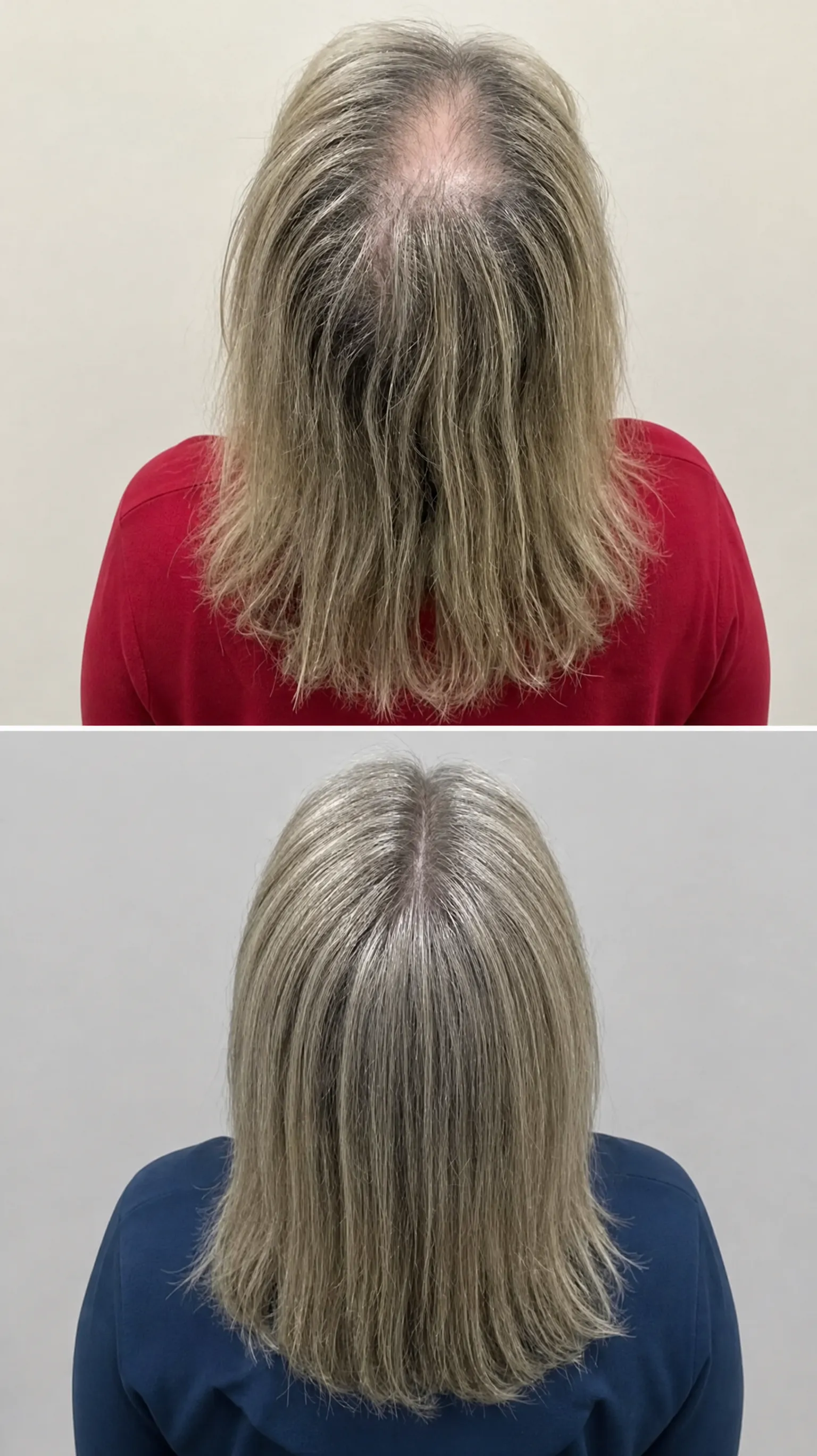
My labs were normal. My part wasn't.
Ad Copy
For 26 years, the first thing anybody saw when they walked into our clinic was the top of my head. I sit. They stand. That's the job. Front desk at a pediatric clinic in Knoxville, Tennessee. Moms, dads, grandmas, car seats, a line out the door every flu season. Everybody looking down at me under four fluorescent tubes. Then one Tuesday in March, a little boy in a dinosaur raincoat tugged his mother's sleeve, pointed at me, and said it loud enough for the whole waiting room. "Mama. Miss Sharon's hair has a hole in it." He was seven. Seven-year-olds don't lie. That's what makes them so hard to work with. I laughed. I printed his paperwork. Then I went into the staff bathroom and cried with the paper towel dispenser running so nobody would hear. Over four years I spent $892.68 trying to cover that hole. Plus ten hats I refuse to add up. Every dollar of it went to the wrong end of the hair. I didn't know that until I found a paper a biochemist named Bruce Ames published in PNAS in 2006. He called it the triage theory. I have run a waiting room for 26 years. I know triage better than I know my own phone number. And when I read that paper, my "normal" checkups and my wider part finally stopped arguing with each other. My hair wasn't broken. It was sitting in the lobby, and nobody was ever going to call its name. I wrote the whole thing down. The receipts, the research, the ridiculous things I did to hide it, and what I finally changed. It's all in the article, including: Why my bloodwork came back "normal" four years in a row while my part kept spreading. (My doctor wrote "WNL" in the margin. I had to look it up.) The waiting room rule the body follows when it runs short, and where hair sits in line. (A biochemist wrote the rule in 2006. I just recognized the room.) Why everything I bought was working on the wrong end of the hair. Why a year of biotin gummies did wonders for my nails and nothing for my part. (My sister still doesn't believe me.) Why moving my part to the other side only bought me about three weeks. Why the hair in my shower drain was never the real problem. The question I never asked in four years of shopping. The ten-second claw clip test I do every Sunday morning. It tells me more than every mirror in my house. What's in my lunch bag on a bad day at the desk now, compared to the vending machine years. What I changed, and the mistake I made the first time I tried it. PLUS: what I'd do first if I were 57 again, with the shoebox still empty. If a stranger had shown me this a few years ago, I'd have figured she was selling something and kept scrolling. So I'll say it plain. It wasn't fast. It wasn't magic. And I don't understand every word in a science journal. I understand a waiting room. My name is Sharon. I'm 61. I've lived in Knoxville my whole life, I've been married to Ron for 38 years, and I have parted my hair on the left since the Carter administration. It started the year I turned 57. That was the year Ron had his bypass. I'd work the desk from 7:30 to 4, drive to the hospital, go home to feed the dog, then drive back. Dinner was a bag of Fritos and a Diet Coke out of the vending machine on the fourth floor. Sleep was whatever happened in the recliner next to his bed. Menopause was already living in my house like a rude cousin. Night sweats at 3 AM, every night. Ron came home after eleven days. He got better. My hair didn't. Because my life never slowed back down. Cardiac rehab with Ron three evenings a week. The desk till 4. Night sweats at 3. Lunch was whatever the break room vending machine had in row C. That went on for three more years. First it was the part. Same side since I was thirteen. Then one morning under the bathroom light it looked like somebody had pressed a ruler into the top of my head. I color my hair, so every four weeks the roots grew out. And under the roots, scalp. Then the drain. I bought a mesh catcher at Walgreens, and every Saturday I pulled out a wad of wet hair the size of a cotton ball and just stood there holding it. Then the pillowcase. I started picking strands off it before Ron woke up, like a woman hiding evidence. Then the brush. Then the car headrest. Then the collar of my scrubs. Then my left temple. A little gap opened up where my hairline used to be, and I started pulling a few pieces forward and pinning them down with a bobby pin. Then the claw clip. At 57 it took the big tortoiseshell one to hold my hair up for work. At 58, the medium. At 59, the little one. At 60 the little one slid right out by 10 AM and clattered on the floor behind my desk. Every year, one size smaller. Like a tree ring going the wrong way. So I started hiding it. I got very good at hiding it. I moved my part to the right. That bought me about three weeks. I bought a magnifying mirror with a light ring around it so I could check my part every morning before work. Worst $39.99 I ever spent. Nobody needs to see that much of herself at 6 AM. I swapped the bulb over our bathroom sink for a softer one. Ron asked if we were having a power problem. I asked our office manager to take out the fluorescent tube right over my chair. I told her it gave me headaches. It did not give me headaches. On weekends I wore hats. I live in East Tennessee, where it's 94 degrees in July, and I wore a hat to the pool, to Food City, to my granddaughter's softball games and to Sunday dinner on my sister's screened porch. I own eleven hats. I used to own one. And every time somebody pulled out a phone, I said "Oh, let me take it!" so I'd be behind the camera instead of under it. Meanwhile, I was shopping. I kept every receipt in a shoebox in the hall closet. Twenty-six years of copays, and I cannot throw away a receipt. Thickening shampoo and conditioner, $32 a set, 11 sets: $352. Root touch-up spray to color in my part, $11.99 a can, 16 cans: $191.84. I touched up my scalp every morning the way Ron touches up the porch rail. Hair fibers, $29.95 a canister, 3 canisters: $89.85. They worked great until it rained at my nephew's graduation in Chattanooga and little streaks of color ran down my forehead in front of 400 people. A clip-in hair topper, $219. In Tennessee humidity it felt like wearing a small, damp animal to church. It lives in a drawer now. The magnifying mirror: $39.99. Total: $892.68. And my part still looked like a ruler. I wasn't only putting things on it, either. I chewed biotin gummies every morning for over a year, because my sister swore by them. My nails had never looked better. The top of my head never noticed. So I brought it up with my doctor. Four checkups in a row. Thyroid, iron, the whole panel. One year she sent me back for a second round of bloodwork. Every year, the same answer. She wrote WNL in the margin. Within normal limits. "Probably just stress," she said. "And age." I wanted to lay my head down on her little rolling desk and make her look. Then came the Fourth of July. My son-in-law Kyle got a drone for Christmas. He flew it over the dock at Norris Lake to get "the whole family from above." That night he plugged it into the TV so everybody could watch. Twenty-two people on a dock, waving up at the sky. And right in the middle, a woman in a navy top with a pale spot on the crown of her head the size of a coffee can lid, shining up at the sun. My granddaughter said, "Mamaw, is that you?" It was me. On a 65-inch TV. In 4K. I'd worn a hat to the lake. I took it off for twelve minutes to swim. Twelve minutes was all that drone needed. I couldn't sleep that night, which was nothing new. But this time I didn't go looking for another spray. I got the shoebox out of the hall closet, dumped it on the guest bed, and asked a different question. Not "what should I buy." Why. Why was this happening, when every test said I was fine? That's how I found Bruce Ames. His paper came out in PNAS in 2006, and it laid out what he called the triage theory. The way I understood it: when the body runs short on what it needs, it doesn't share evenly. It triages. The things that keep a woman alive get served first. Hair gets whatever is left. I read it twice on my phone at 2 AM, sitting on that guest bed in a pile of receipts, and laughed out loud. Ron hollered from the other room to ask if I was okay. It was the kind of laugh that's half crying. Because I know triage. Triage is my whole day. A baby with a 104 fever walks in, she goes straight back. A kid with a wart sits in the lobby with a coloring book. On a normal day, the wart gets seen by lunch. On a bad day in January, with half the county coughing in my waiting room, the wart waits all afternoon. Sometimes the wart gets rescheduled. Sometimes the wart gets rescheduled three times. My hair was the wart. Those years, I was running on vending machine food, night sweats and recliner sleep. Ron came home, but my waiting room never emptied. My hair never had a prayer of getting called back. My labs said I was fine. My hair said I wasn't. For the first time, both of those made sense to me. Then I looked at the shoebox again, and that's when it got embarrassing. Every single thing in it worked on the end of the hair I could see. I painted it, puffed it, sprayed it and glued fibers to it. The other end never got a dime. I'd spent $892.68 putting nicer magazines in the lobby. The patient still never got called back. What I did about it is in the article. I got it wrong the first time, and I want anybody who reads it to skip that part. Here's what changed for me, in plain words, because I'd want to know. It was slow. Slower than I wanted. Hair grows on its own schedule, and it does not care one bit about mine. The first thing I noticed was the drain. Less in it on Saturdays. Then less on the pillowcase, and I quit getting up early to pick it clean. My part got narrower. It looks like a part again instead of a ruler. The crown that lit up on Kyle's TV looks like a crown again. The bathroom light doesn't shine through it anymore. I put the bright bulb back. The little gap at my left temple, the one I'd been pinning over, looks full enough that I put the bobby pins away and moved my part back to the left. Where it's been since I was thirteen. My ponytail feels like a ponytail in my hand again. And the big tortoiseshell claw clip is back. It stays put till 4. Tammy, who has done my color for 19 years, charged me for extra color last month. First time in my life I've been happy to pay it. I asked our office manager to put the tube back in over my chair. And last month, that same little boy came in with his mom. He's eight now. He leaned on my counter, looked right at the top of my head, and didn't say one word. Best review I ever got. That's my story. My hair, my head, my four years. Every woman's hair is different, and I'm a receptionist, not a doctor. But I wrote it for every woman who has ever moved her part to the other side and hoped nobody would ask. Who has picked strands off a pillowcase before anybody else woke up. Who has changed a light bulb to a softer one on purpose. Who has said "let me take it!" so she'd be behind the camera instead of under it. Who owns more hats than the weather can explain. Who has a shoebox, or a drawer, or a whole bathroom cabinet full of things that only ever touched the hair she could already see. I wish somebody had sat me down years earlier and asked me why, instead of what. The whole story is in the article. The receipts, the paper, the waiting room, and what I finally changed. P.S. The paper, for anyone who wants to look it up: Bruce Ames, PNAS, 2006, the triage theory. It's about what the body feeds first. Where my hair fit in, I figured out on a guest bed at 2 AM, surrounded by receipts. P.P.S. I still have the eleven hats. I wear them for the sun now, which is what hats are for. P.P.P.S. Kyle still flies that drone at every family thing. This year I swam at the lake without a hat, watched the video on the big TV with everybody else, and didn't have to leave the room. P.P.P.P.S. If I could get one thing back, it wouldn't be the $892.68. It would be four years of saying "let me take it!" I'm in the pictures now. 👉 Tap "Learn More" below.
More from Noor Hair USA
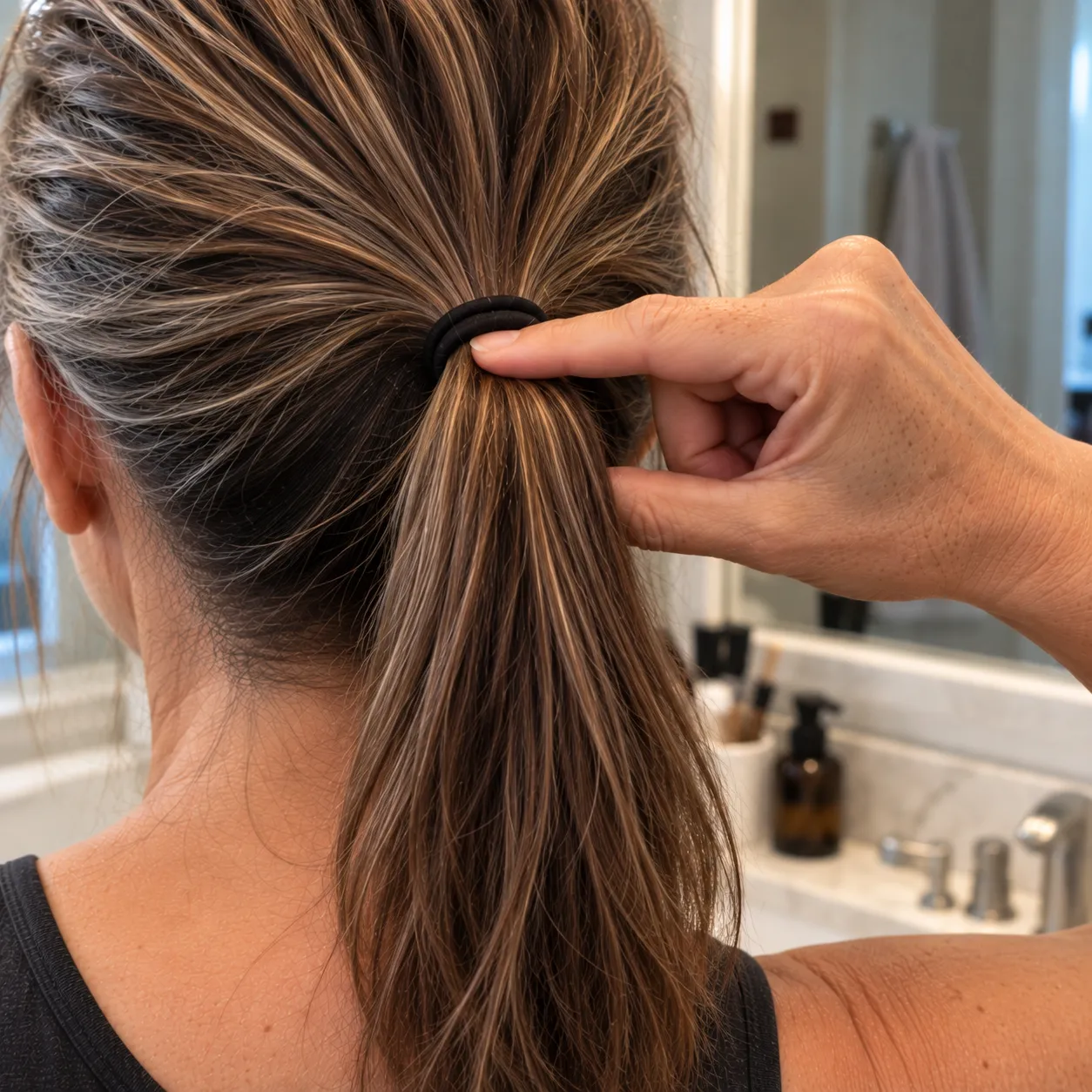
I put $2,000 down on a hair transplant. My old charge nurse is 73 and she is the reason I never had it.
Noor Hair USA
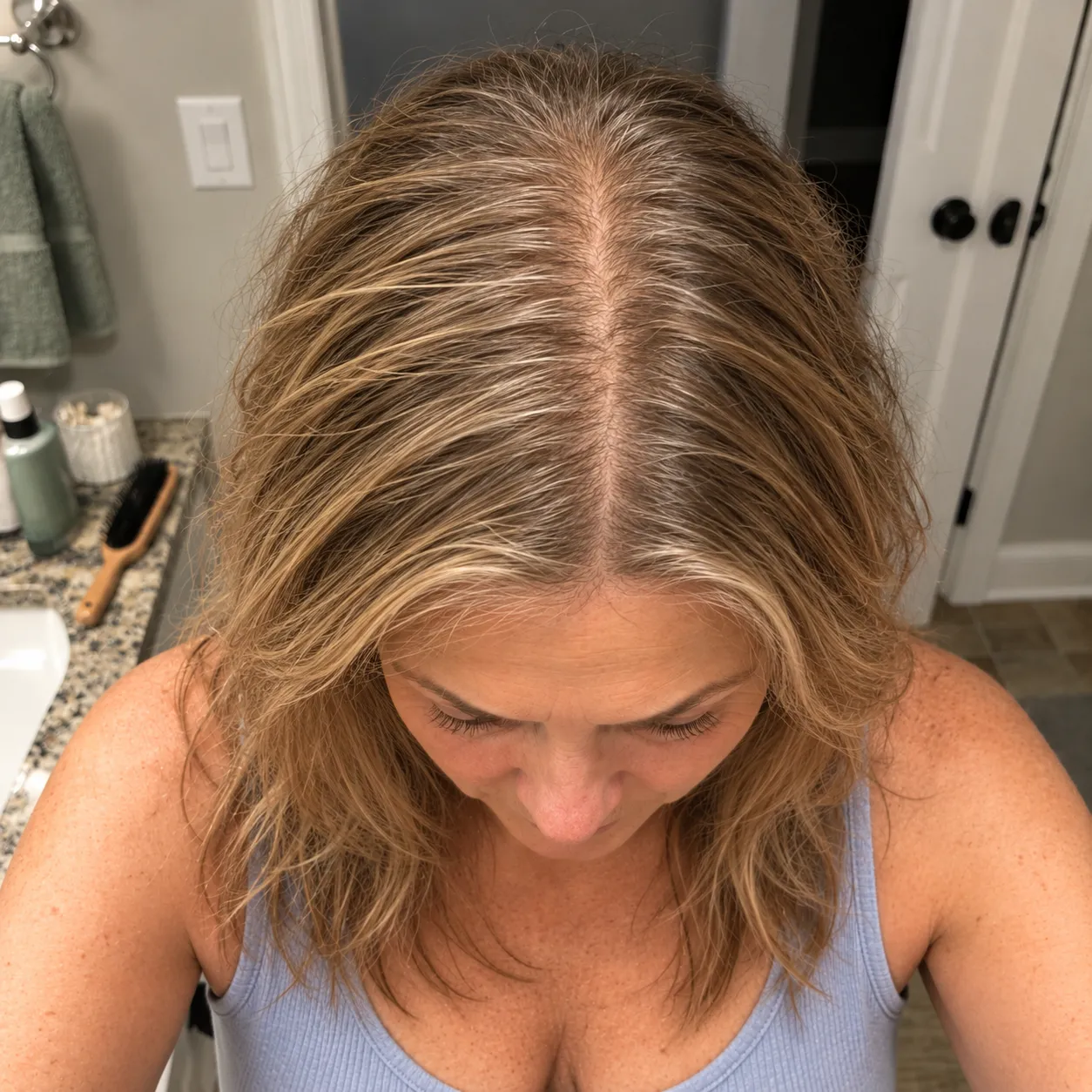
Thinning Hair With Normal Labs? Read This.
Noor Hair USA
Top Hairstylist: Do This to Fix Thin Hair
Noor Hair USA

Thin Hair + 60+ Years Old? Do this every morning...
Noor Hair USA

Thin Hair + 60+ Years Old? Do this every morning...
Noor Hair USA

Thin Hair + 60+ Years Old? Do this every morning...
Noor Hair USA

Thin Hair + 60+ Years Old? Do this every morning...
Noor Hair USA

Thin Hair + 60+ Years Old? Do this every morning...
Noor Hair USA

Thin Hair + 60+ Years Old? Do this every morning...
Noor Hair USA

Thin Hair + 50+ Years Old? Do this every morning...
Noor Hair USA

Thin Hair + 50+ Years Old? Do this every morning...
Noor Hair USA

Thin Hair + 50+ Years Old? Do this every morning...
Noor Hair USA

 Add to Chrome