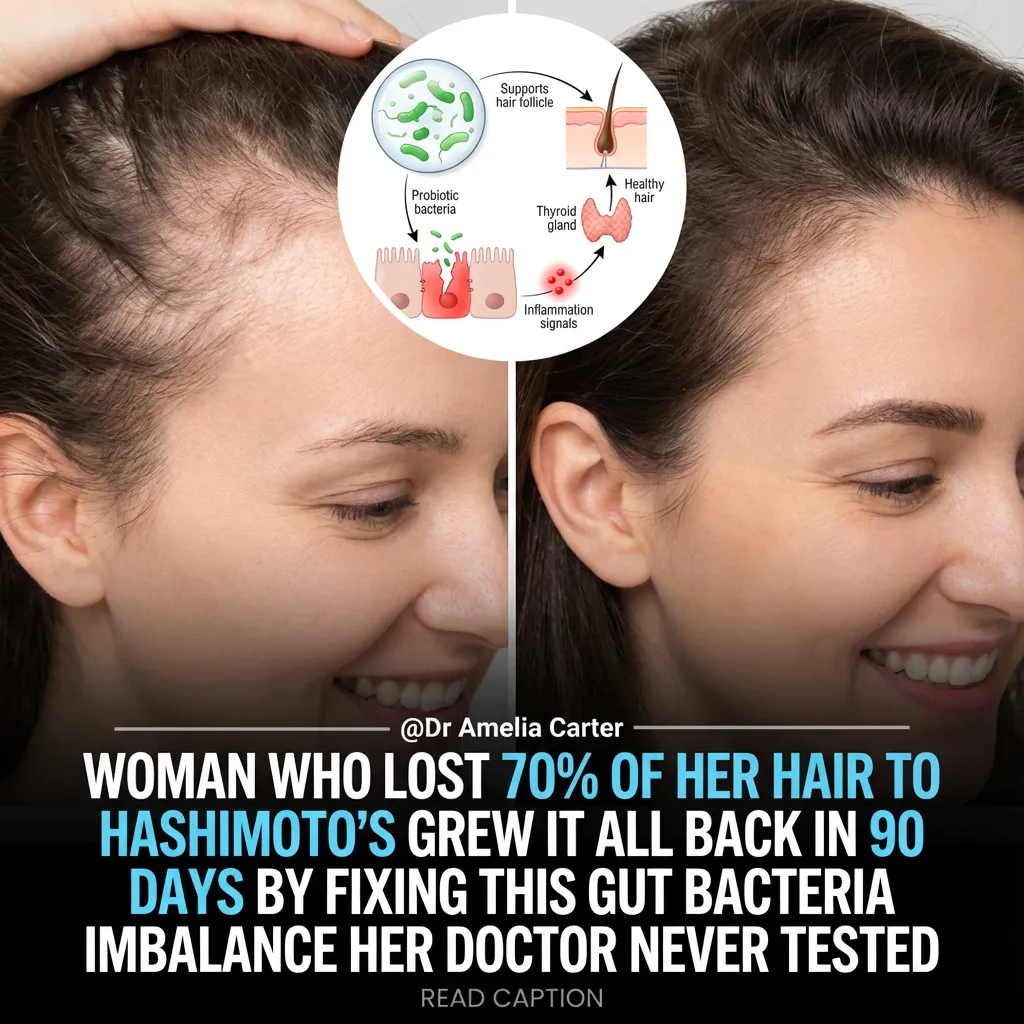
👉 Click here to restore your hairline ASAP
Ad Copy
My name is Dr. Amelia Carter, I'm a board-certified endocrinologist, and I need to tell you something about Hashimoto's hair loss that's going to make you angry. For the last sixteen years, I've been treating Hashimoto's patients with levothyroxine. Sixteen years. Thousands of women. Adjusting doses, monitoring TSH levels, following protocol. And most of them were STILL losing hair in large clumps every single morning. Last month, I sat across from a patient—let's call her Jennifer—who'd been on levothyroxine for six years. Her TSH was perfect. 2.3. Textbook optimal. She'd lost about 60% of her hair density. Dry, brittle strands along the hairline. Her part line widening. She'd started wearing hats constantly. I pulled up her latest labs and showed her: "Jennifer, your TSH is exactly where we want it." She started crying. "Then why is my hair still falling out in clumps every morning?" I had no answer. That's when everything changed. Let me back up. Three years ago, I attended an endocrinology conference in Boston. A esearch team presented findings on Hashimoto's patients experiencing massive hair loss despite optimal TSH levels. They'd done something unusual: instead of just measuring TSH, they analyzed selenium and ferritin levels at the hair follicle. The results were shocking. 94% of Hashimoto's patients with hair loss showed severe selenium deficiency—even with "normal" TSH levels. Their TSH looked perfect on standard blood tests. But their hair follicles? Completely starved of the minerals needed to stay in growth phase. Same levothyroxine dose. Same "perfect" labs. Same hair falling out in the shower every day. The only difference? These patients had severe mineral depletion that their Hashimoto's antibodies were causing daily. "Dr. Carter," the lead researcher said, "levothyroxine treats TSH levels. But it doesn't replace the minerals your Hashimoto's antibodies are destroying every single day. Your patients' hair follicles are starving." She explained it like this: "Your Hashimoto's antibodies burn through selenium attacking your thyroid. By the time your hair follicles try to use it, there's nothing left." She showed me research about how hair follicles need selenium to convert T4 to T3—the process that keeps them in growth phase instead of shedding phase. Hair follicles require three specific minerals to stay healthy: Selenium (to convert T4 to T3 at the follicle) Ferritin (90+ ng/mL to prevent telogen effluvium) Zinc (for follicle structure and growth) Levothyroxine provides T4 hormone. But it doesn't provide ANY of these minerals. And Hashimoto's antibodies destroy them daily. She explained: "It's like trying to grow plants but your immune system keeps pulling nutrients from the soil. The water is there. But the roots can't access what they need." I thought about all those Hashimoto's patients. All those dose adjustments—increasing from 50mcg to 75mcg to 100mcg. And their hair follicles were mineral-depleted the entire time. The researcher had been testing pharmaceutical-grade sublingual minerals alongside levothyroxine in her Boston practice specifically for Hashimoto's patients. Eight weeks later, her patients reported that their hair shedding had "stopped almost completely" and baby hairs were "appearing where I hadn't had hair in years." Meanwhile, my patients had been getting levothyroxine alone. And they were still finding large clumps in the shower drain—just with "normal" TSH levels. I was furious. Not at levothyroxine—it's doing what it's designed to do. But at the APPROACH. How is it that we prescribe levothyroxine to Hashimoto's patients but never test for the mineral deficiency their antibodies are causing? How is it that endocrinology training focuses on TSH optimization but ignores what hair follicles actually need to stop shedding? How is it that Hashimoto's patients spend thousands on medication but nothing to replace the minerals their antibodies are destroying daily? I flew back and immediately started testing my Hashimoto's patients for selenium, zinc, and ferritin. The results were devastating. 94% were deficient in selenium. 89% had ferritin below 40 ng/mL (doctors call this "normal" but hair needs 90+). 78% were deficient in zinc. These were patients I'd been treating for YEARS. Adjusting their levothyroxine doses. Telling them their TSH looked "perfect." And they had severe mineral depletion causing telogen effluvium—large clump shedding—the entire time. I called Jennifer that week and asked her to come back for mineral testing. She was severely deficient. Selenium at 62 mcg/L (should be 120+). Ferritin at 22 ng/mL (hair needs 90+). I explained, "Jennifer, your Hashimoto's antibodies are burning through these minerals daily protecting your thyroid. Your hair follicles are getting zero. Give it 8-12 weeks." I recommended pharmaceutical-grade sublingual minerals—not pills that get destroyed by Hashimoto's gut inflammation but liquid drops that absorb directly into the bloodstream and reach hair follicles. She started immediately. What choice did she have? Keep taking levothyroxine while her hair follicles starved? Week 1-2: Just taking her daily dropper alongside levothyroxine. Nothing visible yet. Week 3: She texted me. Less hair in the shower drain. Usually she'd see large clumps wrapped around her fingers. This time noticeably less. Week 6: She sent a photo. The massive shedding had stopped. She wasn't finding hair all over her clothes, pillow, car seat anymore. Week 9: She noticed baby hairs. Along her hairline. At her temples. Places where her hair had receded over the last three years. Week 12: I ran a full panel including Free T3 and ferritin. Her ferritin had jumped from 22 to 87 ng/mL—almost at the 90+ level hair follicles need. Her Free T3 was optimal. Her hair follicles were finally able to use her levothyroxine. "The minerals are working," I told her. "Your follicles can finally stay in growth phase instead of being forced into shedding phase." She started crying. But this time from relief. "Why didn't anyone tell me this SIX YEARS ago?" she asked. I had no answer. Because I should have known. We ALL should have known. Here's what makes me angry: Levothyroxine costs Hashimoto's patients hundreds per year. Brand-name Synthroid can cost over $1,000 annually. And nowhere—not in medical school, not in endocrinology training, not from pharmaceutical companies—did anyone emphasize that Hashimoto's patients need mineral support because their antibodies destroy minerals daily. Levothyroxine replaces T4. But it doesn't replace the selenium, ferritin, and zinc that Hashimoto's antibodies burn through attacking the thyroid. I was treating Hashimoto's hair loss with half a strategy. I'm writing this for two reasons: First: If you have Hashimoto's and you're losing hair despite taking levothyroxine, you're only addressing HALF the problem. Levothyroxine treats your TSH. That's important. But it doesn't replace the minerals your Hashimoto's antibodies are destroying daily. It doesn't stop your hair follicles from being mineral-starved. It doesn't prevent telogen effluvium. For that, you need pharmaceutical-grade mineral support designed specifically for Hashimoto's—all three minerals in sublingual form that bypasses gut inflammation. Second: If no one told you this, please don't blame your endocrinologist. Doctors are focused on TSH optimization. Testing selenium and ferritin at hair follicle levels isn't part of standard Hashimoto's treatment protocols. But it should be. And WE can add it ourselves. I now recommend pharmaceutical-grade sublingual mineral support to EVERY Hashimoto's patient in my practice who's experiencing hair loss. Their hair hasn't magically regrown overnight. But their massive shedding has stopped. Baby hairs are appearing. Their hair texture is improving. Patients report less hair in the shower drain, new growth at the hairline, hair that's no longer dry and brittle—all from replacing the minerals their Hashimoto's antibodies destroy daily. I wish I'd learned about this sixteen years and thousands of Hashimoto's patients ago. But at least I know now. If you have Hashimoto's and you're losing hair, ask yourself: What am I doing to replace the minerals my antibodies are destroying daily? If the answer is "nothing" or "just levothyroxine," you're only fighting half the battle. The research is clear on sublingual delivery for Hashimoto's patients—it bypasses the gut inflammation and delivers minerals directly to hair follicles. But honestly, after seeing the results in my Hashimoto's patients, I'd recommend it regardless. Because levothyroxine alone isn't enough for Hashimoto's hair loss. The science is clear: treat the TSH + replace the minerals your antibodies destroy = best chance of stopping the shedding. I've been in endocrinology for sixteen years. I've seen too many Hashimoto's patients watch their hair fall out despite "normal" TSH levels. I'm not letting more Hashimoto's patients suffer from incomplete treatment. Neither should you. 👉 https://actora.shop/pages/hashimotos-hairline-study-adv
More from Dr. Amelia Carter
Fix your Thyroid, Naturally
Dr. Amelia Carter
Fix your Thyroid, Naturally
Dr. Amelia Carter

Fix your Thyroid, Naturally
Dr. Amelia Carter
Calm your eyes now — antibodies won't wait
Dr. Amelia Carter
Fix your Thyroid, Naturally
Dr. Amelia Carter
Fix your Thyroid, Naturally
Dr. Amelia Carter
Fix your Thyroid, Naturally
Dr. Amelia Carter
Fix your Thyroid, Naturally
Dr. Amelia Carter
Fix your Thyroid, Naturally
Dr. Amelia Carter
Fix your Thyroid, Naturally
Dr. Amelia Carter
Fix your Thyroid, Naturally
Dr. Amelia Carter
Fix your Thyroid, Naturally
Dr. Amelia Carter

 Add to Chrome